
|
You entered: Elliptical Galaxy
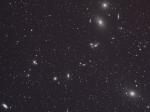 Markarians Chain of Galaxies
16.03.2005
Across the heart of the Virgo Cluster of Galaxies lies a striking string of galaxies known as Markarian's Chain. The chain, pictured above, is highlighted on the upper right with two large but featureless lenticular galaxies, M84 and M86, and connects to the large spiral on the lower left, M88.
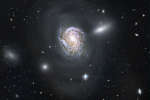 NGC 4911: Spiral Diving into a Dense Cluster
8.09.2010
Why are there faint rings around this spiral galaxy? Possibly because the galaxy, NGC 4911, is being pulled at by its neighbors as it falls into the enormous Coma Cluster of Galaxies.
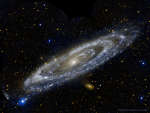 The Andromeda Galaxy in Ultraviolet
18.07.2021
What does the Andromeda galaxy look like in ultraviolet light? Young blue stars circling the galactic center dominate. A mere 2.5 million light-years away, the Andromeda Galaxy, also known as M31, really is just next door as large galaxies go.
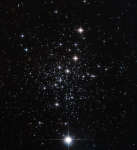 Palomar 12
18.02.2015
Palomar 12 was not born here. The stars of the globular cluster, first identified in the Palomar Sky Survey, are younger than those in other globular star clusters that roam the halo of our Milky Way Galaxy.
 NGC 289: Swirl in the Southern Sky
15.10.2021
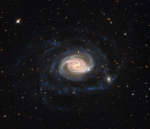
About 70 million light-years distant, gorgeous spiral galaxy NGC 289 is larger than our own Milky Way. Seen nearly face-on, its bright core and colorful central disk give way to remarkably faint, bluish spiral arms. The extensive arms sweep well over 100 thousand light-years from the galaxy's center.
 NGC 289: Swirl in the Southern Sky
5.04.2018
About 70 million light-years distant, gorgeous spiral galaxy NGC 289 is larger than our own Milky Way. Seen nearly face-on, its bright core and colorful central disk give way to remarkably faint, bluish spiral arms. The extensive arms sweep well over 100 thousand light-years from the galaxy's center.
 Galaxy Group Hickson 90
17.05.2017
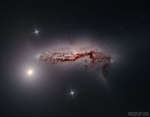
Scanning the skies for galaxies, Canadian astronomer Paul Hickson and colleagues identified some 100 compact groups of galaxies, now appropriately called Hickson Compact Groups (HCGs). This sharp Hubble image shows one such galaxy group, HCG 90, in startling detail.
 Centaurus A
13.03.2010
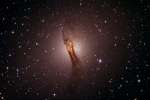
Only 11 million light-years away, Centaurus A is the closest active galaxy to planet Earth. Spanning over 60,000 light-years, the peculiar elliptical galaxy, also known as NGC 5128, is featured in this sharp color image.
 Centaurus A
17.03.2022
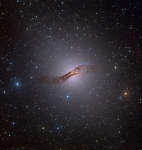
A mere 11 million light-years away, Centaurus A is the closest active galaxy to planet Earth. Spanning over 60,000 light-years, the peculiar elliptical galaxy also known as NGC 5128, is featured in this sharp telescopic view.
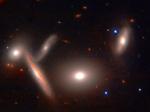 Hickson Compact Group 40
17.02.1999
Galaxies, like stars, frequently form groups. A group of galaxies is a system containing more than two galaxies but less than the tens or hundreds typically found in a cluster of galaxies. A most...
|
January February March April May June July August September |
|||||||||||||||||||||||||||||||||||||||||||||||||