
|
You entered: Solar System
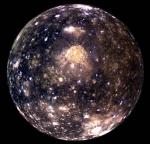 Callisto Enhanced
12.05.1998
Callisto is half rock and half ice. This moon of Jupiter is approximately the size of the planet Mercury, making it the third largest moon in the Solar System, after Ganymede and Titan. Callisto...
 APOD: 2025 November 17 Б Comet Lemmons Wandering Tail
17.11.2025
What has happened to Comet Lemmon's tail? The answer is blowing in the wind Б the wind from the Sun in this case. This continuous outflow of charged particles from...
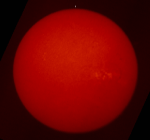 The Sun Today
18.05.1996
Our Sun shows a different face every day. The above picture was taken on May 15, but a similar picture of the Sun actually taken today can be found here. The above picture was taken in red light and so is shown in red.
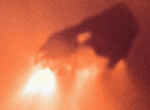 An Orbiting Iceberg
21.08.1995
A comet nucleus, formed from the primordial stuff of the solar system, resembles a very dirty iceberg. Orbiting far from our Sun, it can remain frozen, preserved for billions of years. Occasionally, a chance gravitational encounter will alter this distant orbit and send the nucleus plummeting towards the inner solar system.
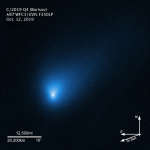 Interstellar Interloper 2I Borisov
18.10.2019
After the 2017 detecton of 1I/'Oumuamua, comet 2I/Borisov has become the second recognized interstellar interloper. Like 'Oumuamua, Borisov's measured hyperbolic trajectory and speed as it falls toward the Sun confirm that its origin is from beyond our Solar System.
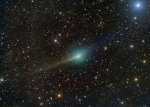 3I/ATLAS Flyby
26.12.2025
Attention grabbing interstellar visitor 3I/ATLAS made its not-so-close flyby of our fair planet on December 19 at a distance of 1.8 astronomical units. That's about 900 light-seconds. This deep exposure captures the comet...
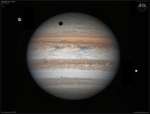 Ganymede s Shadow
25.03.2017
Approaching opposition early next month, Jupiter is offering some of its best telescopic views from planet Earth. On March 17, this impressively sharp image of the solar system's ruling gas giant was taken from a remote observatory in Chile.
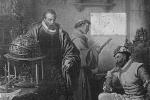 APOD is Two Years Old Today
16.06.1997
The first Astronomy Picture of the Day (APOD) appeared two years ago today. Pictured above is a scene surrounding the creation of an early APOD, depicting the famous astronomer Tycho Brahe demonstrating a celestial globe to Emperor Rudolph II. The image of a possible optical counterpart to a gamma-ray burst appears on the back wall.
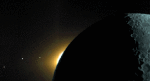 The Ecliptic Plane
21.09.1996
The Plane of the Ecliptic is illustrated in this Clementine star tracker camera image which reveals (from right to left) the Moon lit by Earthshine, the Sun's corona rising over the Moon's dark limb, and the planets Saturn, Mars, and Mercury.
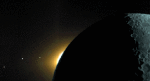 The Ecliptic Plane
14.10.2000
The Plane of the Ecliptic is well illustrated in this picture from the 1994 lunar prospecting Clementine spacecraft. Clementine's star tracker camera image reveals (from right to left) the Moon lit by Earthshine, the Sun's corona rising over the Moon's dark limb, and the planets Saturn, Mars, and Mercury.
|
January February March April May June July August September |
|||||||||||||||||||||||||||||||||||||||||||||||||