
|
You entered: Spitzer space telescope
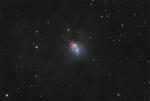 Dusty NGC 1300
6.10.2006
Dusty NGC 1333 is seen in visible light as a reflection nebula, dominated by bluish hues characteristic of starlight reflected by dust. But at longer infrared wavelengths, the interstellar dust itself glows. Moving your...
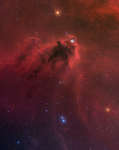 LDN 1622: Dark Nebula in Orion
21.02.2020
The silhouette of an intriguing dark nebula inhabits this cosmic scene. Lynds' Dark Nebula (LDN) 1622 appears against a faint background of glowing hydrogen gas only visible in long telescopic exposures of the region. In contrast, the brighter reflection nebula vdB 62 is more easily seen, just above and right of center.
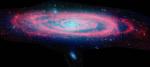 Infrared Andromeda
9.06.2006
This wide, detailed Spitzer Space Telescope view features infrared light from dust (red) and old stars (blue) in Andromeda, a massive spiral galaxy a mere 2.5 million light-years away. In fact, with over twice the diameter of our own Milky Way, Andromeda is the largest nearby galaxy.
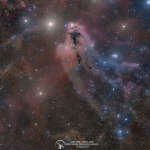 LDN 1622: Dark Nebula in Orion
22.01.2026
The silhouette of an intriguing dark nebula inhabits this cosmic scene. Lynds' Dark Nebula (LDN) 1622 appears against a faint background of glowing hydrogen gas only visible in long telescopic exposures of the region. In contrast, a brighter reflection nebula, vdB 62, is more easily seen just above the dusty dark nebula.
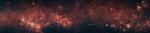 GLIMPSE the Milky Way
16.12.2005
Scroll right and gaze through the dusty plane of our Milky Way Galaxy in infrared light. The cosmic panorama is courtesy of the Galactic Legacy Infrared Mid-Plane Survey Extraordinaire (GLIMPSE) project and the Spitzer Space Telescope.
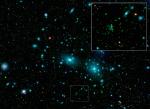 Dwarf Galaxies in the Coma Cluster
31.05.2007
In visible light images, over a thousand galaxies are seen to lie within a volume about 20 million light-years across in the rich Coma Galaxy Cluster. But infrared images of the Coma Cluster have now been used to add thousands more to the Coma's galaxy count in the form of previously undiscovered dwarf galaxies.
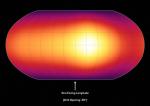 HD 189733b: Hot Jupiter
12.05.2007
HD 189733b is a Jupiter-sized planet known to orbit a star some 63 light-years away. But while the distant world is approximately the size of Jupiter, its close-in orbit makes it much hotter than our solar system's ruling gas giant.
 APOD: 2007 February 23- Dust and the Helix Nebula
23.02.2007
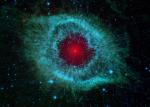
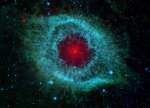
Dust makes this cosmic eye look red. The eerie Spitzer Space Telescope image shows infrared radiation from the well-studied Helix Nebula (NGC 7293) a mere 700 light-years away in the constellation Aquarius.
 Dust and the Helix Nebula
31.12.2009
Dust makes this cosmic eye look red. The eerie Spitzer Space Telescope image shows infrared radiation from the well-studied Helix Nebula (NGC 7293) a mere 700 light-years away in the constellation Aquarius.
 The Helix Nebula in Infrared
20.09.2016
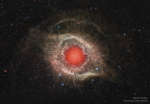
What makes this cosmic eye look so red? Dust. The featured image from the robotic Spitzer Space Telescope shows infrared light from the well-studied Helix Nebula (NGC 7293) a mere 700 light-years away in the constellation of the Water Carrier Aquarius.
|
January February March April May June July August September October |
|||||||||||||||||||||||||||||||||||||||||||||||||