
|
You entered: arcs
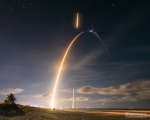 Launch and Landing
13.01.2018
A composite of three consecutive exposures, this night skyscape follows the January 7 launch and first stage landing of a Falcon 9 rocket from a beach on planet Earth's space coast. With...
 APOD: 2024 October 28 Б STEVE: A Glowing River over France
28.10.2024
Sometimes a river of hot gas flows over your head. In this case the river created a Strong Thermal Emission Velocity Enhancement (STEVE) that glowed bright red, white, and pink. Details of how STEVEs...
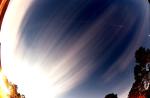 International Space Station Trail
14.12.2000
Still under construction, the International Space Station is literally becoming one of the brightest, fastest moving stars in the heavens. Despite illuminated clouds and bright light from a nearly full moon (lower left), this...
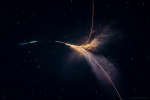 Falcon 9 Boostback
12.03.2020
Short star trails appear in this single 84 second long exposure, taken on March 6 from a rotating planet. The remarkable scene also captures the flight of a Falcon 9 rocket and Dragon cargo spacecraft over Cape Canaveral Air Force Station shortly after launch, on a resupply mission bound for the International Space Station.
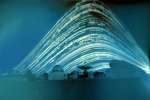 Days in the Sun
21.01.2012
From solstice to solstice, this six month long exposure compresses time from the 21st of June till the 21st of December, 2011, into a single point of view. Dubbed a solargraph, the unconventional picture was recorded with a pinhole camera made from a drink can lined with a piece of photographic paper.
 Equinox 1
30.03.2001
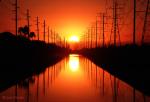
Twice a year, at the Spring and Fall equinox, the Sun rises due east. In an emphatic demonstration of this celestial alignment, photographer Joe Orman recorded this inspiring image of the Sun rising exactly along the east-west oriented Western Canal, in Tempe, Arizona, USA.
 Abell 1689 Warps Space
9.01.2003
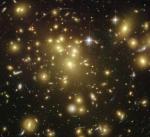
Two billion light-years away, galaxy cluster Abell 1689 is one of the most massive objects in the Universe. In this view from the Hubble Space Telescope's Advanced Camera for Surveys, Abell...
 Falcon 9 and Milky Way
14.05.2016
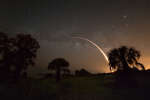
On May 6, the after midnight launch of a SpaceX Falcon 9 rocket lit up dark skies over Merritt Island, planet Earth. Its second stage bound for Earth orbit, the rocket's arc seems to be on course for the center of the Milky Way in this pleasing composite image looking toward the southeast.
 Comet Hale-Bopp Inbound
19.12.1996
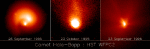
Headed toward the inner Solar System, the much anticipated Comet Hale-Bopp has promised to put on a big show next spring. The comet's apparent brightness is currently approaching 4th magnitude and its inbound journey has been closely followed by many observers.
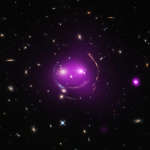 Gravity s Grin
26.10.2019
Albert Einstein's general theory of relativity, published over 100 years ago, predicted the phenomenon of gravitational lensing. And that's what gives these distant galaxies such a whimsical appearance, seen through the looking glass of X-ray and optical image data from the Chandra and Hubble space telescopes.
|
January February March April May June July August September |
|||||||||||||||||||||||||||||||||||||||||||||||||