
|
You entered: interstellar dust
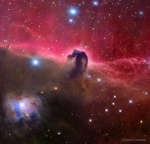 The Magnificent Horsehead Nebula
13.05.2015
Sculpted by stellar winds and radiation, a magnificent interstellar dust cloud by chance has assumed this recognizable shape. Fittingly named the Horsehead Nebula, it is some 1,500 light-years distant, embedded in the vast Orion cloud complex.
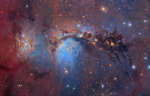 M78: Stardust and Starlight
10.10.2013
Interstellar dust clouds and bright nebulae abound in the fertile constellation of Orion. One of the brightest, M78, is just left of center in this colorful telescopic view, covering an area north of Orion's belt. At a distance of about 1,500 light-years, the bluish nebula itself is about 5 light-years across.
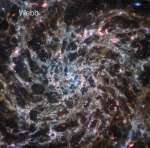 Webb and Hubble: IC 5332
26.02.2026
What does the universe look like through infrared goggles? Our eyes can only see visible light, but astronomers want to see more. TodayБs APOD shows spiral galaxy IC 5332 as seen by two NASA telescopes: Webb in mid-infrared and Hubble in ultraviolet and visible light.
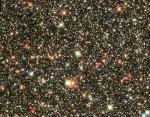 Sagittarius Star Cloud
20.05.2001
Stars come in all different colors. The color of a star indicates its surface temperature, an important property used to assign each star a spectral type. Most stars in the above Sagittarius Star Cloud are orange or red and relatively faint, as our Sun would appear.
 Massive Star Forming Region DR21 in Infrared
14.04.2004
Deep in the normally hidden recesses of giant molecular cloud DR21, a stellar nursery has been found creating some of the most massive stars yet recorded. The orbiting Spitzer Space Telescope's Infrared Array Camera opened the window into the cloud last year in mid- infrared light.
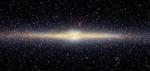 The Milky Way in Infrared
29.12.1997
At night, from a dark location, part of the clear sky looks milky. This unusual swath of dim light is generally visible during any month and from any location. Until the invention of the telescope, nobody really knew what the "Milky Way" was.
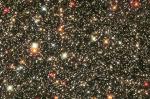 Sagittarius Star Cloud
13.01.1999
Stars come in all different colors. The color of a star indicates its surface temperature, an important property used to assign each star a spectral type. Most stars in the above Sagittarius Star Cloud are orange or red and relatively faint, as our Sun would appear.
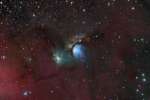 M78 Wide Field
26.11.2009
Interstellar dust clouds and glowing nebulae abound in the fertile constellation of Orion. One of the brightest, M78, is centered in this colorful, wide field view, covering an area north of Orion's belt. At a distance of about 1,500 light-years, the bluish reflection nebula is around 5 light-years across.
 APOD: 2025 August 29 Б A Dark Veil in Ophiuchus
29.08.2025
The diffuse hydrogen-alpha glow of emission region Sh2-27 fills this cosmic scene. The field of view spans nearly 3 degrees across the nebula-rich constellation Ophiuchus toward the central Milky Way. A Dark Veil...
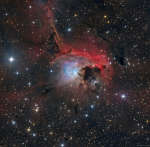 NGC 2626 along the Vela Molecular Ridge
4.02.2023
Centered in this colorful cosmic canvas, NGC 2626 is a beautiful, bright, blue reflection nebula in the southern Milky Way. Next to an obscuring dust cloud and surrounded by reddish hydrogen emission from large H II region RCW 27 it lies within a complex of dusty molecular clouds known as the Vela Molecular Ridge.
|
January February March April May June July August September |
|||||||||||||||||||||||||||||||||||||||||||||||||