
|
You entered: nearby stars
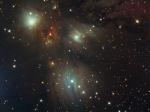 Still Life with NGC 2170
3.03.2005
In this beautiful celestial still life composed with a cosmic brush, dusty nebula NGC 2170 shines at the upper left. Reflecting the light of nearby hot stars, NGC 2170 is joined by other bluish reflection nebulae and a compact red emission region against a backdrop of stars.
 Young Star Cluster NGC 1333
12.09.2024
This spectacular mosaic of images from the James Webb Space Telescope peers into the heart of young star cluster NGC 1333. A mere 1,000 light-years distant toward the heroic constellation Perseus, the nearby star cluster lies at the edge of the large Perseus molecular cloud.
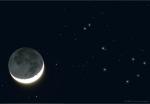 April s Moon and the Pleiades
14.04.2005
After parting with the Sun late last week, April's moon graced the early evening sky. Its slender, three-day-old crescent shares this lovely telescopic skyview with the nearby Pleiades star cluster. Here, the Moon...
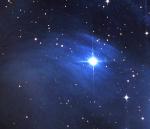 Reflection Nebula NGC 1435
1.03.1999
Reflection nebulae reflect light from a nearby star. Many small carbon grains in the nebula reflect the light. The blue color typical of reflection nebula is caused by blue light being more efficiently scattered by the carbon dust than red light.
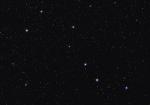 The Big Dipper Cluster
17.03.2006
A well-known asterism in northern skies, The Big Dipper is easy to recognize even when viewed upside down. Part of the larger constellation of Ursa Major, the bright dipper stars above are named (left to right along the dipper) Dubhe, Merak, Phecda, Megrez, Alioth, Mizar/Alcor, and Alkaid.
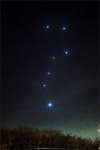 The Big Dipper Enhanced
16.03.2015
Do you see it? This common question frequently precedes the rediscovery of one of the most commonly recognized configurations of stars on the northern sky: the Big Dipper. This grouping of stars is one of the few things that has likely been seen, and will be seen, by every human generation.
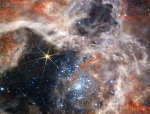 Tarantula Stars R136 from Webb
7.09.2022
Near the center of a nearby star-forming region lies a massive cluster containing some of the largest and hottest stars known. Collectively known as star cluster NGC 2070, these stars are part of the vast Tarantula Nebula and were captured in two kinds of infrared light by the new Webb Space Telescope.
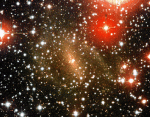 Galaxy Dwingeloo 1 Emerges
17.10.1995
If you look closely at the center of the above photograph, you will see a spiral galaxy behind the field of stars. Named Dwingeloo 1, this nearby galaxy was only discovered recently (1994) because much of its light was obscured by dust, gas and bright stars of our own Milky Way galaxy.
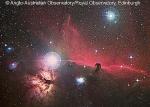 Orion's Horsehead Nebula
27.08.2000
The Horsehead Nebula is one of the most famous nebulae on the sky. It is visible as the black indentation to the red emission nebula seen just to the right of center of the above photograph. The bright star near the center is located in the belt of the familiar constellation of Orion.
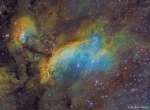 IC 4628: The Prawn Nebula
4.07.2016
South of Antares, in the tail of the nebula-rich constellation Scorpius, lies emission nebula IC 4628. Nearby hot, massive stars, millions of years young, radiate the nebula with invisible ultraviolet light, stripping electrons from atoms. The electrons eventually recombine with the atoms to produce the visible nebular glow, dominated by the red emission of hydrogen.
|
January February March April May June July August |
||||||||||||||||||||||||||||||||||||||||||||||||||||||||