
|
You entered: nearest stars
 APOD: 2023 December 26 Б IC 443: The Jellyfish Nebula
26.12.2023
Why is this jellyfish swimming in a sea of stars? Drifting near bright star Eta Geminorum, seen at the right, the Jellyfish Nebula extends its tentacles from the bright arcing ridge of emission left of center.
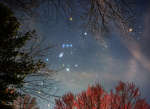 Orion Spring
25.03.2015
As spring comes to planet Earth's northern hemisphere, familiar winter constellation Orion sets in early evening skies and budding trees frame the Hunter's stars. The yellowish hue of cool red supergiant Alpha Orionis, the great star Betelgeuse, mingles with the branches at the top of this colorful skyscape.
 A December Winter Night
28.12.2024
Orion seems to come up sideways, climbing over a distant mountain range in this deep skyscape. The wintry scene was captured from southern Poland on the northern hemisphere's long solstice night. Otherwise unseen nebulae hang in the sky, revealed by the camera modified to record red hydrogen-alpha light.
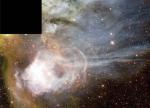 N44C: A Nebular Mystery
14.05.2002
Why is N44C glowing so strangely? The star that appears to powers the nebula, although young and bright, does not seem hot enough to create some of the colors observed. A search for a hidden hotter star in X-rays has come up empty.
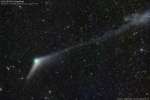 Comet Catalina Tails
1.01.2016
A new year's treat for binoculars, as 2016 begins Comet Catalina (C/2013 US10) now sweeps through planet Earth's predawn skies near bright Arcturus, alpha star of Bootes. But this telescopic mosaic from December 21 follows the pretty tails of the comet across a field of view as wide as 10 full moons.
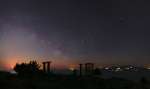 Take a Picture of Saturn
19.07.2013
Take a picture of Saturn in the sky tonight. You could capture a view like this one. Recorded just last month looking toward the south, planet Earth and ruins of the ancient temple of Athena at Assos, Turkey are in the foreground.
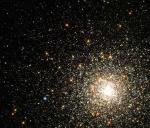 M80: A Dense Globular Cluster
7.07.1999
If our Sun were part of M80, the night sky would glow like a jewel box of bright stars. M80, also known as NGC 6093, is one of about 250 globular clusters that survive in our Galaxy.
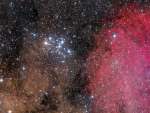 M6: The Butterfly Cluster
3.09.2014
To some, the outline of the open cluster of stars M6 resembles a butterfly. M6, also known as NGC 6405, spans about 20 light-years and lies about 2,000 light years distant. M6, pictured...
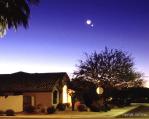 Venus, Moon, and Neighbors
6.04.2000
Rising before the Sun on February 2nd, astrophotographer Joe Orman anticipated this apparition of the bright morning star Venus near a lovely crescent Moon above a neighbor's house in suburban Phoenix, Arizona, USA.
 When Vega is North
8.05.2015
In only about 12,000 years Vega will be the North Star, the closest bright star to our fair planet's North Celestial Pole. By then, when you fix your camera to a tripod...
|
January February March April May June July August September |
|||||||||||||||||||||||||||||||||||||||||||||||||