
|
You entered: north pole
 APOD: 2026 April 4 Б Hello World
4.04.2026
From pole to pole our fair planet is captured in this snapshot from space, an evocative image from a window of the Orion spacecraft Integrity. From the spacecraft's perspective the Sun is moving behind Earth's bright limb along the lower right.
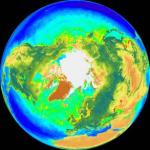 Ocean Planet Pole To Pole
7.10.1998
The Sea-viewing Wide Field-of-view Sensor (SeaWiFS) instrument onboard the orbiting SeaStar spacecraft can map subtle differences in Earth's ocean color. These North (left) and South Pole projections are based on SeaWiFS measurements made between September 1997 and July 1998.
 Aurora Crown the Earth
27.05.1996
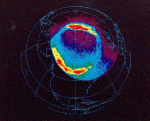
What do aurora look like from space? The POLAR spacecraft answered this by photographing an auroral oval surrounding the north pole of the Earth, causing displays on both the night and day side. The auroral sub-storm, pictured in false-color above, developed within 15 minutes and may have lasted as long as on hour.
 Northern Pluto
27.02.2016
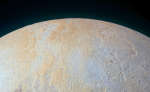
Gaze across the frozen canyons of northern Pluto in this contrast enhanced color scene, imaged last July by the New Horizons spacecraft. Currently known as Lowell Regio, the region has been informally named for Percival Lowell, founder of the Lowell Observatory.
 Shakespeare in Space
29.12.2023
In 1986, Voyager 2 became the only spacecraft to explore ice giant planet Uranus close up. Still, this newly released image from the NIRCam (Near-Infrared Camera) on the James Webb Space Telescope offers a detailed look at the distant world. The tilted outer planet rotates on its axis once in about 17 hours.
 APOD: 2025 February 23 Б Saturn in Infrared from Cassini
23.02.2025
Saturn looks slightly different in infrared light. Bands of clouds show great structure, including long stretching storms. Also quite striking in infrared is the unusual hexagonal cloud pattern surrounding Saturn's North Pole. Each side of the dark hexagon spans roughly the width of our Earth.
 X-Ray Earth
16.09.2000
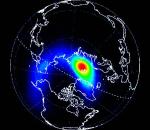
Above is a picture of the Earth in x-rays, taken in March of 1996 from the orbiting Polar satellite. Most of the planet is dark with superposed continent and coordinate grids, while the bright x-ray emission near the north pole is shown in red. Why does the Earth have an x-ray glow?
 Sunrise over the Parthenon
21.06.2009
Today, the sun will stay in the sky longer than any other day of the year, as seen from the northern hemisphere of Earth. Named the Summer Solstice, today's maximum daylight is indicative of the high amount of sunlight this time of year that is primarily responsible for the heat of the summer season.
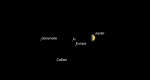 Juno Approaching Jupiter
1.07.2016
Approaching over the north pole after nearly a five-year journey, Juno enjoys a perspective on Jupiter not often seen, even by spacecraft from Earth that usually swing by closer to Jupiter's equator. Looking...
 Castle Eye View
7.04.2017
The best known asterism in northern skies, The Big Dipper is easy to recognize, even when viewed upside down, though some might see a plough or wagon. The star names and the familiar outlines...
|
January February March April May June July August September October |
|||||||||||||||||||||||||||||||||||||||||||||||||