
|
You entered: partial solar eclipse
 ISS Double Transit
12.09.2015
Not once, but twice the International Space Station transits the Sun on consecutive orbits of planet Earth in this video frame composite. The scene was captured on August 22 from a single well-chosen location in Schmalenbeck, Germany where the ISS created intersecting shadow paths only around 7 kilometers wide.
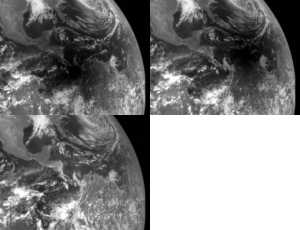 Moon Shadow
12.03.1998
When the Moon's shadow reached out and touched the Earth last month, the result was a Solar Eclipse. Such an eclipse is total only for observers located along a narrow path corresponding to the ground track of the shadow's dark central portion or "umbra".
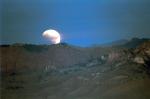 Eclipse Over The Mountain
2.09.1999
Undaunted by world wide anticipation of the August 11 total solar eclipse, the moon also performed a lunar eclipse just two weeks earlier, on July 28. Crossing the edge of Earth's shadow the moon was only partially eclipsed - but the spectacle could be seen by observers located across the Earth's night side.
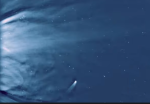 APOD: 2025 March 31 Б Parker: The Solar System from Near the Sun
31.03.2025
If you watch long enough, a comet will appear. Before then, you will see our Solar System from inside the orbit of Mercury as recorded by NASA's Parker Solar Probe looping around the Sun.
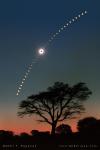 Eclipse Over Acacia
3.12.2002
On December 4th, for the second time in as many years, the Moon's shadow will track across southern Africa bringing a total solar eclipse to African skies. Reaching Africa just before...
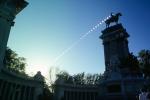 Eclipse Madrid
7.10.2005
A walk in the park seemed like a perfect idea to many enjoying a sunny October morning in Madrid, Spain. Of course, on October 3rd an added attraction was the Moon - seen in dramatic silhouette during an annular solar eclipse.
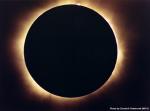 Sun Block
18.08.1999
During a total solar eclipse, Earth's moon blocks the sun - almost exactly. While the sun is about 400 times wider than the moon, it is also about 400 times farther away and each appears to be half a degree or so in diameter.
 Easter Island Eclipse
14.07.2010
Makemake, a god in Easter Island mythology, may have smiled for a moment as clouds parted long enough to reveal this glimpse of July 11's total solar eclipse to skygazers. In the foreground...
 Ring of Fire Revisited
30.05.2003
Early on Saturday, May 31 (UT) the new Moon will once again slide across the Sun's fiery disk, and once again an annular solar eclipse will be the result -- since the Moon's apparent diameter will be a little too small to completely cover the Sun.
 Reunion Island Eclipse
3.09.2016
The New Moon's dark shadow crossed planet Earth on September 1. In silhouette the Moon didn't quite cover the Sun though, creating an an annular solar eclipse. The shadow's narrow central path was about 100 kilometers wide at maximum eclipse.
|
January February March April May June July August September |
|||||||||||||||||||||||||||||||||||||||||||||||||