
|
You entered: solar wind
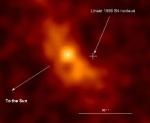 X-Rays from Comet LINEAR
1.08.2000
Why do comets emit X-rays? First discovered during the passing of Comet Hyakutake in 1996, the reason a cold comet would produce hot X-rays has since remained a mystery. On July 14, however...
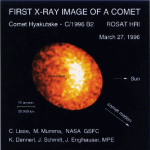 Unexpected X-rays from Comet Hyakutake
11.04.1996
The first X-rays ever detected from a comet were discovered from Comet Hyakutake with the ROSAT satellite on March 27th. The discovery is particularly surprising because there was little previous indication that comets emit any significant X-radiation.
 APOD: 2025 November 25 Б Comet Lemmon and the Milky Way
25.11.2025
What did Comet Lemmon look like when it was at its best? One example is pictured here, featuring three celestial spectacles all at different distances. The closest spectacle is the snowcapped Meili Mountains, part of the Himalayas in China.
 APOD: 2024 June 4 Б Comet Pons Brooks Develops Opposing Tails
4.06.2024
Why does Comet Pons-Brooks now have tails pointing in opposite directions? The most spectacular tail is the blue-glowing ion tail that is visible flowing down the image. The ion tail is pushed directly out from the Sun by the solar wind. On the upper right is the glowing central coma of Comet 12P/PonsБBrooks.
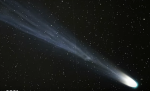 Video: Comet Leonard over One Hour
25.01.2022
Which direction is this comet heading? Judging by the tail, one might imagine that Comet Leonard is traveling towards the bottom right, but a full 3D analysis shows it traveling almost directly away from the camera.
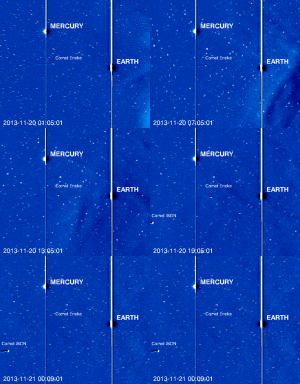 Comet ISON from STEREO
23.11.2013
Still intact, on November 21 Comet ISON (C/2012 S1) swept into this animated field of view (left) from the HI-1 camera on the STEREO-A spacecraft. The camera has also captured periodic Comet Encke, Mercury, and Earth, with the Sun cropped out of the frame at the right, the source of the billowing solar wind.
 The Dust and Ion Tails of Comet Hale Bopp
27.12.2000
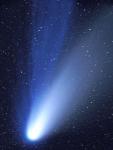
In 1977, Comet Hale-Bopp's intrinsic brightness exceeded any comet since 1811. Since it peaked on the other side of the Earth's orbit, however, the comet appeared only brighter than any comet in two decades. Visible above are the two tails shed by Comet Hale-Bopp.
 Tails of Comet Lemmon
6.05.2013
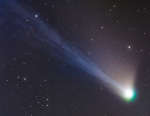
What caused the interestingly intricate tails that Comet Lemmon displayed earlier this year? First of all, just about every comet that nears the Sun displays two tails: a dust tail and an ion tail.
 APOD: 2023 August 15 Б A Triply Glowing Night Sky over Iceland
15.08.2023
The Sun is not the quiet place it seems. It expels an unsteady stream of energetic electrons and protons known as the solar wind. These charged particles deform the Earth's magnetosphere, change paths...
 Comet Hale-Bopp Outbound
10.09.1997
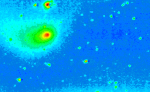
Hale-Bopp, the Comet of the Century, is leaving the inner Solar System. Outbound at about 12 miles per second it is presently nearing the main asteroid belt between Mars and Jupiter. This false-color image represents a recent view from low Earth orbit showing the comet surrounded by its shrinking coma against a background of stars.
|
January February March April May June July August September October |
|||||||||||||||||||||||||||||||||||||||||||||||||