
|
You entered: spacecraft
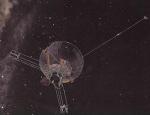 Pioneer 10: The First 6 Billion Miles
3.03.1997
Q: What was made by humans and is 6 billion miles away? A: Pioneer 10 - and yesterday was the 25th anniversary of its launch. More than 9 light hours distant, Pioneer 10 is presently about twice as far from the Sun as Pluto, bound for interstellar space at 28,000 miles per hour.
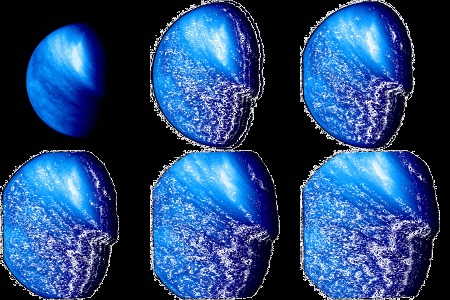 Venus Express Arrives at Venus
17.07.2006
Humanity now has a spacecraft orbiting Venus. The robotic Venus Express spacecraft launched by the European Space Agency in 2005 November arrived at Venus in 2006 April. Venus Express is now orbiting Earth's sister planet and returning pictures.
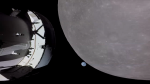 Earthset from Orion
23.11.2022
Eight billion people are about to disappear in this snapshot from space. Taken on November 21, the sixth day of the Artemis 1 mission, their home world is setting behind the Moon's bright edge as viewed by an external camera on the outbound Orion spacecraft.
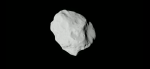 Rosetta Approaches Asteroid Lutitea
24.04.2012
What would it look like to approach an asteroid in a spaceship? In 2010, ESA's robotic Rosetta spacecraft zipped past the asteroid 21 Lutetia taking data and snapping images in an effort to better determine the history of the asteroid and the origin of its unusual colors.
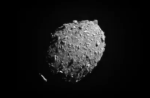 DART: Impact on Asteroid Dimorphos
27.09.2022
Could humanity deflect an asteroid headed for Earth? Yes. Deadly impacts from large asteroids have happened before in Earth's past, sometimes causing mass extinctions of life. To help protect our Earth from some...
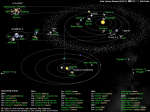 Humanity Explores the Solar System
30.04.2013
What spacecraft is humanity currently using to explore our Solar System? Presently, every inner planet has at least one robotic explorer, while several others are monitoring our Sun, some are mapping Earth's Moon, a few are chasing asteroids and comets, one is orbiting Saturn, and several are even heading out into deep space.
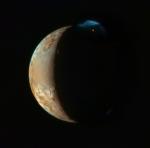 New Horizons at Io
4.04.2007
Spewed from a volcano, a complex plume rises over 300 kilometers above the horizon of Jupiter's moon Io in this image from cameras onboard the New Horizons spacecraft. The volcano, Tvashtar, is marked by the bright glow (about 1 o'clock) at the moon's edge, beyond the terminator or night/day shadow line.
 MESSENGER s Last Day on Mercury
1.05.2025
The first to orbit inner planet Mercury, the MESSENGER spacecraft came to rest on this region of Mercury's surface on April 30, 2015. Constructed from MESSENGER image and laser altimeter data, the projected scene looks north over the northeastern rim of the broad, lava filled Shakespeare basin.
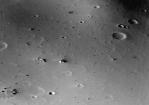 18 Miles From Deimos
19.09.1998
Diminutive Deimos is the smallest of the two tiny Moons of Mars. Potato-shaped and barely 6 miles wide this asteroid-like body was visited by the Viking 2 orbiter in 1977. This image was made when the spacecraft approached to within 18 miles of Deimos' surface.
 The Far Side
14.09.1995
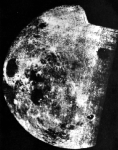
This historic picture was humanity's first glimpse of the far side of the Moon. It was taken by the Soviet spacecraft Luna 3 in October of 1959. Luna 3 followed closely...
|
January February March April May June July August September October |
|||||||||||||||||||||||||||||||||||||||||||||||||