
|
You entered: Milky Way
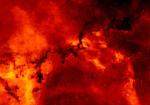 Hydrogen and Dust in the Rosette Nebula
23.12.2005
At the edge of a large molecular cloud in Monoceros, some 3,000 light years away, dark filaments of dust are silhouetted by luminous hydrogen gas. The close up view of the Rosette Nebula...
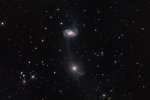 Galaxies on a String
2.07.2010
Galaxies NGC 5216 (top) and NGC 5218 really do look like they are connected by a string. Of course, that string is a cosmic trail of gas, dust, and stars about 22,000 light-years long.
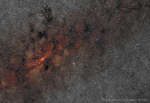 The Galactic Center in Infrared
17.01.2016
The center of our Galaxy is a busy place. In visible light, much of the Galactic Center is obscured by opaque dust. In infrared light, however, dust glows more and obscures less, allowing nearly one million stars to be recorded in the featured photograph.
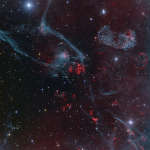 Puppis A Supernova Remnant
29.09.2017
Driven by the explosion of a massive star, supernova remnant Puppis A is blasting into the surrounding interstellar medium about 7,000 light-years away. At that distance, this colorful telescopic field based on broadband and narrowband optical image data is about 60 light-years across.
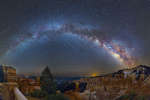 Meteors, Planes, and a Galaxy over Bryce Canyon
6.05.2018
Sometimes land and sky are both busy and beautiful. The landscape pictured in the foreground encompasses Bryce Canyon in Utah, USA, famous for its many interesting rock structures eroded over millions of years.
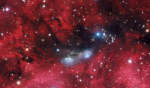 The NGC 6914 Complex
30.08.2018
A study in contrasts, this colorful skyscape features stars, dust, and glowing gas in the vicinity of NGC 6914. The complex of reflection nebulae lies some 6,000 light-years away, toward the high-flying northern constellation Cygnus and the plane of our Milky Way Galaxy.
 Saturn: 1993 2022
19.08.2022
Saturn is the most distant planet of the Solar System easily visible to the unaided eye. With this extraordinary, long-term astro-imaging project begun in 1993, you can follow the ringed gas giant for one Saturn year as it wanders once around the ecliptic plane, finishing a single orbit around the Sun by 2022.
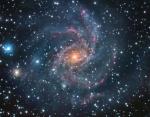 Facing NGC 6946
4.10.2002
From our vantage point in the Milky Way Galaxy, we see NGC 6946 face on. The big beautiful spiral galaxy is located just 10 million light-years away, behind a veil of foreground stars in the high and far-off constellation of Cepheus.
 The Andromeda Deep Field
19.05.2003
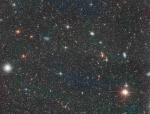
What can you learn from looking into the depths of space? In an effort to find out true ages of stars in neighboring Andromeda galaxy's halo, astronomers stared into the galaxy giant with the new Advanced Camera for Surveys through the Hubble Space Telescope.
 The Perseus Cluster of Galaxies
26.04.1997
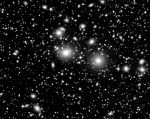
Here is one of the largest objects that anyone will ever see on the sky. Each of the fuzzy blobs in the above picture is a galaxy, together making up the Perseus Cluster, one of the closest clusters of galaxies.
|
January February March April May June July August September October |
|||||||||||||||||||||||||||||||||||||||||||||||||