
|
You entered: Solar System
 Hale-Bopp: The Great Comet of 1997
8.04.2022
Only twenty-five years ago, Comet Hale-Bopp rounded the Sun and offered a dazzling spectacle in planet Earth's night skies. Digitized from the original astrophoto on 35mm color slide film, this classic image of the Great Comet of 1997 was recorded a few days after its perihelion passage on April 1, 1997.
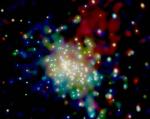 X Ray Mystery in RCW 38
27.12.2002
A mere 6,000 light-years distant and sailing through the constellation Vela, star cluster RCW 38 is full of powerful stars. It's no surprise that these stars, only a million years young with hot outer atmospheres, appear as point-like x-ray sources dotting this x-ray image from the orbiting Chandra Observatory.
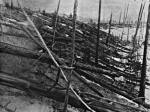 Tunguska: The Largest Recent Impact Event
14.11.2007
Yes, but can your meteor do this? The most powerful natural explosion in recent Earth history occurred on 1908 June 30 when a meteor exploded above the Tunguska River in Siberia, Russia. Detonating with...
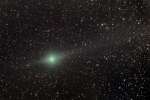 Comet Lulin Approaches
2.02.2009
How bright will Comet Lulin become? No one knows for sure. Although it is notoriously difficult to accurately predict the brightness of newly discovered comets, Comet Lulin could well become visible to the unaided eye later this month.
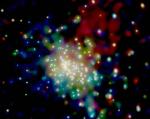 X Ray Mystery in RCW 38
8.01.2005
A mere 6,000 light-years distant and sailing through the constellation Vela, star cluster RCW 38 is full of powerful stars. It's no surprise that these stars, only a million years young with hot outer atmospheres, appear as point-like x-ray sources dotting this x-ray image from the orbiting Chandra Observatory.
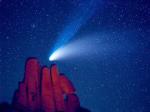 Comet Hale Bopp Over Indian Cove
20.04.2004
Comet Hale-Bopp, the Great Comet of 1997, was quite a sight. No comets of comparable brightness have graced the skies of Earth since then. During this next month, however, even besides the fleeting Comet Bradfield, two comets have a slight chance of rivaling Hale-Bopp and a good chance of putting on a memorable sky show.
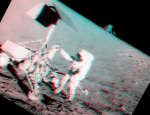 Apollo 12 and Surveyor 3 Stereo View
23.05.2009
Put on your red/blue glasses and gaze into this dramatic stereo view from the surface of the Moon. The 3D scene features Apollo 12 astronaut Pete Conrad visiting the Surveyor 3 spacecraft in November of 1969. The image was carefully created from two separate pictures (AS12-48-7133, AS12-48-7134) taken on the lunar surface.
 APOD: 2023 September 9 Б Comet Nishimura Grows
9.09.2023
Comet Nishimura is growing. More precisely, the tails C/2023 P1 (Nishimura) are growing as it nears the Sun. Discovered only last month, the comet is already near naked eye brightness as it now moves inside the Earth's orbit.
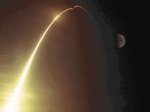 Destination: Moon
8.01.1998
Tuesday, January 6, at 9:28 p.m. EST, NASA's Lunar Prospector spacecraft climbed into the sky above Cape Canaveral Air Station riding an Athena II rocket. Representing NASA's first Moon mission since...
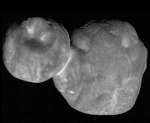 Sharpest Ultima Thule
28.02.2019
On January 1, New Horizons swooped to within 3,500 kilometers of the Kuiper Belt world known as Ultima Thule. That's about 3 times closer than its July 2015 closest approach to Pluto.
|
January February March April May June July August September |
|||||||||||||||||||||||||||||||||||||||||||||||||