
|
You entered: ring
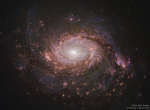 M77: Spiral Galaxy with an Active Center
17.03.2020
What's happening in the center of nearby spiral galaxy M77? The face-on galaxy lies a mere 47 million light-years away toward the constellation of the Sea Monster (Cetus). At that estimated distance, this gorgeous island universe is about 100 thousand light-years across.
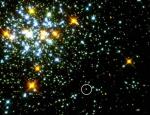 NGC 1818: Pick A Star
15.04.1998
This is NGC 1818, a youthful, glittering cluster of 20,000 stars residing in the Large Magellanic Cloud, 164,000 light-years away. Pick a star. Any star. Astronomers might pick the unassuming bluish-white one (circled) which appears to be a hot newly formed white dwarf star. What makes it so interesting?
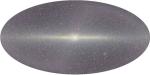 The Near Infrared Sky
18.05.2000
Was this picture taken from outside our Galaxy? No, it is a composite taken from Earth orbit, well inside our Milky Way Galaxy. In light just a little too red for human eyes...
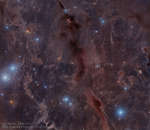 Dark Nebulas across Taurus
14.03.2016
Sometimes even the dark dust of interstellar space has a serene beauty. One such place occurs toward the constellation of Taurus. The filaments featured here can be found on the sky between the Pleiades star cluster and the California Nebula.
 The Colorful Clouds of Rho Ophiuchi
5.07.2016
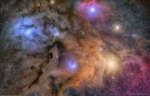
The many spectacular colors of the Rho Ophiuchi (oh'-fee-yu-kee) clouds highlight the many processes that occur there. The blue regions shine primarily by reflected light. Blue light from the star Rho Ophiuchi and nearby stars reflects more efficiently off this portion of the nebula than red light.
 Sedna of the Outer Solar System
16.03.2004
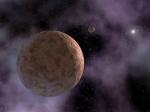
What is the most distant known object in our Solar System? A new answer to this centuries-old question was announced yesterday by NASA with the discovery of a dark red object dubbed Sedna. Although over twice the distance to Pluto, Sedna is near its closest approach to the Sun.
 NGC 1818: Pick A Star
31.05.2003
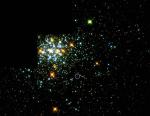
This is NGC 1818, a youthful, glittering cluster of 20,000 stars residing in the Large Magellanic Cloud, 180,000 light-years away. Pick a star. Any star. Astronomers might pick the unassuming bluish-white one (circled) which appears to be a hot newly formed white dwarf star. What makes it so interesting?
 APOD: 2025 September 10 Б The Great Lacerta Nebula
10.09.2025
It is one of the largest nebulas on the sky -- why isn't it better known? Roughly the same angular size as the Andromeda Galaxy, the Great Lacerta Nebula can be found toward the constellation of the Lizard (Lacerta).
 Jupiter's Colorful Clouds
3.08.1996
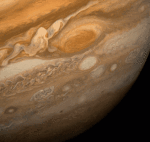
What makes the colors in Jupiter's clouds? With a mean temperature of 120 degrees Kelvin (-153 degrees Celsius) and a composition dominated by Hydrogen (about 90%), and Helium (about 10%) with a smattering...
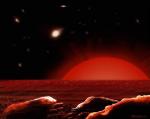 Stars Without Galaxies
27.03.1999
Galaxies are made up of stars, but are all stars found within galaxies? Using the Hubble Space Telescope, researchers exploring the Virgo Cluster of galaxies have now found about 600 red giant stars adrift in intergalactic space. Above is an artist's vision of the sky from a hypothetical planet of such a lonely sun.
|
January February March April May June July August September October |
|||||||||||||||||||||||||||||||||||||||||||||||||