
|
You entered: Solar System
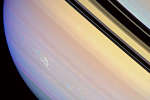 A Persistent Electrical Storm on Saturn
5.05.2008
How do large storms evolve on Saturn? On Earth, a hurricane can persist for weeks, while the Great Red Spot on Jupiter has been in existence for over 150 years. On Saturn, a storm system has now set a new endurance record, now being discernable for greater than three months.
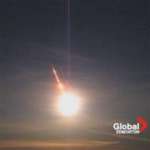 Fireball Over Edmonton
25.11.2008
What if you're driving down the street and an object from space shoots across the sky right in front of you? Such was the case last week for many people in south central Canada.
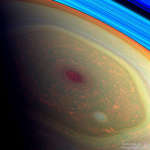 Saturns Northern Hexagon
5.07.2020
Why would clouds form a hexagon on Saturn? Nobody is sure. Originally discovered during the Voyager flybys of Saturn in the 1980s, nobody has ever seen anything like it anywhere else in the Solar System.
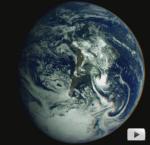 Rotating Earth from Galileo
14.05.2007
When passing Earth on your way to Jupiter, what should you look for? That question arose for the robotic Galileo spacecraft that soundlessly coasted past the Solar System's most photographed orb almost two decades ago.
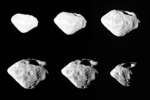 Rosetta Spacecraft Passes Asteroid Steins
8.09.2008
What's that diamond in the sky? Cruising though space, sometimes you'll come across an unusual object. Such was the case on Friday for ESA's Rosetta spacecraft on it's way to comet Churyumov-Gerasimenko in 2014.
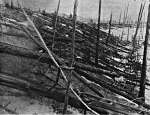 Tunguska: The Largest Recent Impact Event
2.10.2011
Yes, but can your meteor do this? The most powerful natural explosion in recent Earth history occurred on 1908 June 30 when a meteor exploded above the Tunguska River in Siberia, Russia. Detonating with...
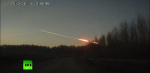 The Great Russian Meteor of 2013
18.02.2013
What in heaven's blazes is that? Thousands of people living near the Ural Mountains in Russia saw last Friday morning one of the more spectacular meteors of modern times streak across the sky. Forceful sound waves arrived at the ground minutes later, knocking people over and breaking windows for hundreds of kilometers.
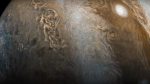 Perijove 11: Passing Jupiter
8.09.2019
Here comes Jupiter! NASA's robotic spacecraft Juno is continuing on its 53-day, highly-elongated orbits around our Solar System's largest planet. The featured video is from perijove 11 in early 2018, the eleventh time Juno has passed near Jupiter since it arrived in mid-2016.
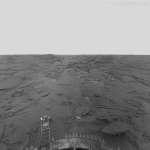 The Surface of Venus from Venera 13
17.03.2021
If you could stand on Venus -- what would you see? Pictured is the view from Venera 13, a robotic Soviet lander which parachuted and air-braked down through the thick Venusian atmosphere in March of 1982.
 APOD: 2025 February 16 Б Perijove 11: Passing Jupiter
16.02.2025
Here comes Jupiter. NASA's robotic spacecraft Juno is continuing on its highly elongated orbits around our Solar System's largest planet. The featured video is from perijove 11 in early 2018, the eleventh time Juno passed near Jupiter since it arrived in mid-2016.
|
January February March April May June July August September |
|||||||||||||||||||||||||||||||||||||||||||||||||