
|
You entered: Sun
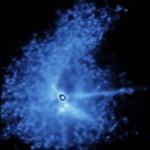 The T Tauri Star Forming System
4.06.2001
What did the Sun look like before there were planets? A prototype laboratory for the formation of low mass stars like our Sun is the T Tauri system, one of the brighter star systems toward the constellation of Taurus. In young systems, gravity causes a gas cloud to condense.
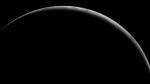 A Crescent Earth at Midnight
21.06.2003
The Earth's northern hemisphere is outlined as a sunlit crescent in this dramatic view from orbit, recorded near local midnight by the Geostationary Operational Environmental Satellite (GOES-8) on June 22, 1996. That...
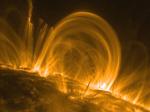 Heating Coronal Loops
14.08.2005
Why is the corona of the Sun so hot? Extending above the photosphere or visible surface of the Sun, the faint, tenuous solar corona can't be easily seen from Earth, but it is measured to be hundreds of times hotter than the photosphere itself.
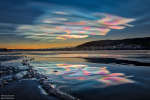 Iridescent Clouds over Sweden
15.01.2020
Why would these clouds multi-colored? A relatively rare phenomenon in clouds known as iridescence can bring up unusual colors vividly or even a whole spectrum of colors simultaneously. These polar stratospheric clouds clouds, also known as nacreous and mother-of-pearl clouds, are formed of small water droplets of nearly uniform size.
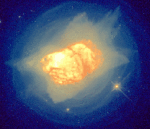 NGC 7027: A Dying Star's Nebula
17.01.1996
This pseudo-color composite of two recent Hubble Space Telescope images is a picture of a Sun-like star nearing the end of its lifetime. The exquisite details visible in this planetary nebula indicate that when...
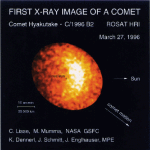 Unexpected X-rays from Comet Hyakutake
11.04.1996
The first X-rays ever detected from a comet were discovered from Comet Hyakutake with the ROSAT satellite on March 27th. The discovery is particularly surprising because there was little previous indication that comets emit any significant X-radiation.
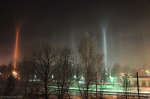 Unusual Light Pillars over Latvia
27.12.2014
What's happening over that town? Close inspection shows these strange columns of light occur over bright lights, and so likely are light pillars that involve falling ice crystals reflecting back these lights. The above image and several similar images were taken with a standard digital camera in Sigulda, Latvia in late 2009.
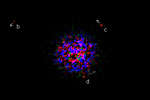 HR 8799: Discovery of a Multi planet Star System
17.11.2008
How common are planetary systems like our own Solar System? In the twelve years previous to 2008, over 300 candidate planetary systems have been found orbiting nearby stars. None, however, were directly imaged, few showed evidence for multiple planets, and many had a Jupiter-sized planet orbiting inside the orbit of Mercury.
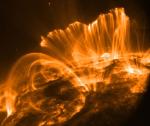 Coronal Rain, Solar Storm
15.11.2000
In this picture, the Sun's surface is quite dark. A frame from a movie recorded on November 9th by the orbiting TRACE telescope, it shows coronal loops lofted over a solar active region.
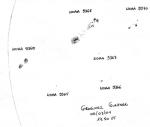 Islands in the Photosphere
15.03.2001
Awash in a sea of plasma and anchored in magnetic fields, sunspots are planet-sized, dark islands in the solar photosphere, the bright surface of the Sun. Before the enlightened(!) age of cameras, solar observers created detailed drawings of sunspots as they changed and progressed across the visible solar disk.
|
January February March April May June July August September October |
|||||||||||||||||||||||||||||||||||||||||||||||||