
|
You entered: Earth's moon
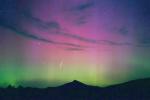 A Perseid Aurora
21.08.2000
Just after the Moon set but before the Sun rose in the early morning hours of August 12, meteors pelted the Earth from the direction of the constellation Perseus, while ions pelted the Earth from the Sun.
 Phaethon s Brood
12.12.2024
Based on its well-measured orbit, 3200 Phaethon (sounds like FAY-eh-thon) is recognized as the source of the meteoroid stream responsible for the annual Geminid meteor shower. Even though most meteor shower parents are comets, 3200 Phaethon is a known and closely tracked near-Earth asteroid with a 1.4 year orbital period.
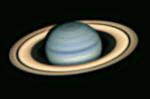 Saturn from Earth
2.09.1998
Saturn is the second largest planet in our Solar System. Saturn has been easily visible in the sky since history has been recorded. Galileo used one of the first telescopes in 1610 to discover Saturn's rings, which he first thought were moons.
 From Moonrise to Sunset
22.11.2008
In this panorama of Earth and sky recorded on Thursday, November 13, the Full Moon rises along the eastern horizon at the far left. Of course, the Full Moon rises at sunset and that Thursday's setting Sun was also captured at the far right.
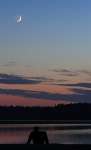 Calm, Crescent Moon, and Venus
21.05.2010
Last weekend, the Moon and Venus formed a beautiful close pair in the west after sunset, a scene enjoyed by skygazers all over the world. In this lovely view of the conjunction from Sweden, a calm lake Vallentuna lies in the foreground with sunset colors still fading behind the treeline on the far shore.
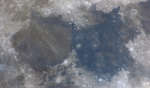 APOD: 2026 July 25 Б Tranquility and Serenity
25.07.2026
The Seas of Tranquility and Serenity are calm today. They're calm most every day though, since they are actually lunar maria, ancient lava flows filling in large impact basins on the Moon. Also...
 Starburst Galaxy Messier 94
6.03.2025
Beautiful island universe Messier 94 lies a mere 15 million light-years distant in the northern constellation of the hunting dogs, Canes Venatici. A popular target for earth-based astronomers, the face-on spiral galaxy is about 30,000 light-years across, with spiral arms sweeping through the outskirts of its broad disk.
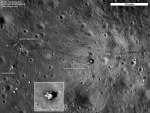 Apollo 17 Site: A Sharper View
8.09.2011
This view of the Apollo 17 landing site in the Taurus-Littrow valley was captured last month by the Lunar Reconnaissance Orbiter (LRO), the sharpest ever recorded from space. The high resolution image data...
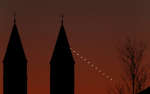 The Last Days of Venus as the Evening Star
6.01.2022
That's not a young crescent Moon posing behind cathedral towers after sunset. It's Venus in a crescent phase. About 40 million kilometers away and about 2 percent illuminated by sunlight...
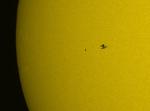 Sharp Silhouette
21.09.2006
Though it's 93 million miles away, the Sun still hurts your eyes when you look at it. But bright sunlight (along with accurate planning and proper equipment!) resulted in this sharp silhouette of spaceship and space station.
|
January February March April May June July August September |
|||||||||||||||||||||||||||||||||||||||||||||||||