
|
You entered: Earth orbit
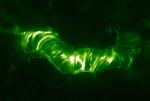 AR9077: Solar Magnetic Arcade
20.07.2000
On July 14th, solar active region 9077 (AR9077) produced a massive flare. The event also blasted an enormous cloud of energetic charged particles toward planet Earth, triggering magnetic storms and dramatic auroral displays. This striking close-up of AR9077 was made by the orbiting TRACE satellite shortly after the flare erupted.
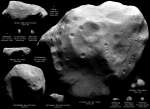 Lutetia: The Largest Asteroid Yet Visited
26.07.2010
As humans explore the universe, the record for largest asteroid visited by a spacecraft has increased yet again. Earlier this month, ESA's robotic Rosetta spacecraft zipped past the asteroid 21 Lutetia taking data and snapping images in an effort to better determine the history of the asteroid and the origin of its unusual colors.
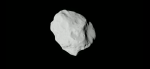 Rosetta Approaches Asteroid Lutitea
24.04.2012
What would it look like to approach an asteroid in a spaceship? In 2010, ESA's robotic Rosetta spacecraft zipped past the asteroid 21 Lutetia taking data and snapping images in an effort to better determine the history of the asteroid and the origin of its unusual colors.
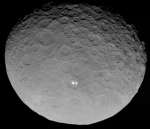 Dwarf Planet, Bright Spot
14.05.2015
Now at Ceres, Dawn's camera recorded this closer view of the dwarf planet's northern hemisphere and one of its mysterious bright spots on May 4. A sunlit portrait of a small, dark...
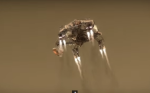 Perseverance: Seven Minutes to Mars
16.02.2021
How hard is it to land safely on Mars? So hard that many more attempts have failed than succeeded. The next attempt will be on Thursday. The main problem is that the Martian atmosphere is too thick to ignore -- or it will melt your spacecraft.
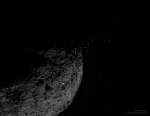 Gravel Ejected from Asteroid Bennu
16.09.2020
Why does asteroid Bennu eject gravel into space? No one is sure. The discovery, occurring during several episodes by NASA's visiting ORISIS-REx spacecraft, was unexpected. Leading ejection hypotheses include impacts by Sun-orbiting meteoroids, sudden thermal fractures of internal structures, and the sudden release of a water vapor jet.
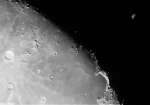 The Moon Eclipses Saturn
16.07.2014
What happened to half of Saturn? Nothing other than Earth's Moon getting in the way. As pictured above on the far right, Saturn is partly eclipsed by a dark edge of a Moon itself only partly illuminated by the Sun.
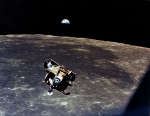 From the Moon to the Earth
19.07.2009
After the most famous voyage of modern times, it was time to go home. After proving that humanity has the ability to go beyond the confines of planet Earth, the first humans to walk...
 A Star Where Photons Orbit
4.01.1997
The above computer animated picture depicts how a very compact star would look to a nearby observer. The star pictured is actually more compact that any known except a black hole, so it is only hypothetical. The observer is situated at the photon sphere, where photons can orbit in a circle.
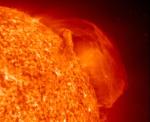 Erupting Sun
18.09.1997
On August 27th twisting magnetic fields propelled this huge eruptive prominence a hundred thousand miles above the Sun's surface. The seething plasma of ionized gases is at a temperature of about 150,000 degrees Farenheit and spans over 200,000 miles (about 27 Earths).
|
January February March April May June July August September October |
|||||||||||||||||||||||||||||||||||||||||||||||||