
|
You entered: apod
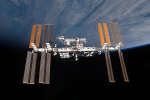 The International Space Station Over the Horizon
7.12.2009
This was home. Just over a week ago, the STS-129 crew of the Space Shuttle Atlantis undocked from the International Space Station (ISS) and returned to Earth. As the shuttle departed the space station, they took the above image. Visible on the ISS are numerous modules, trusses, and long wing-like solar panels.
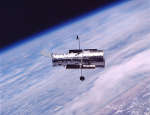 Two New Hubble Quality Telescopes Gifted to NASA
10.06.2012
What if you were given a new Hubble telescope for free? How about two? The astronomical community is abuzz with just this opportunity as the US National Reconnaissance Office has unexpectedly transferred ownership of two space-qualified Hubble-quality telescopes to NASA.
 A Venus Transit Over the Baltic Sea
13.06.2012
Waiting years and traveling kilometers -- all to get a shot like this. And even with all of this planning, a good bit of luck was helpful. As the Sun rose over the Baltic...
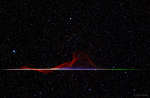 A Colorful Quadrantid Meteor
2.02.2021
Meteors can be colorful. While the human eye usually cannot discern many colors, cameras often can. Pictured is a Quadrantids meteor captured by camera over Missouri, USA, early this month that was not only impressively bright, but colorful. The radiant grit, likely cast off by asteroid 2003 EH1, blazed a path across Earth's atmosphere.
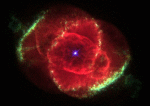 The Cat's Eye Nebula (Revisited)
4.07.1996
Three thousand light years away, a dying star throws off shells of glowing gas. This image from the Hubble Space Telescope reveals "The Cat's Eye Nebula" to be one of the most complex planetary nebulae known.
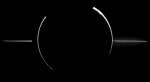 Jupiters Rings Revealed
6.01.2008
Why does Jupiter have rings? Jupiter's rings were discovered in 1979 by the passing Voyager 1 spacecraft, but their origin was a mystery. Data from the Galileo spacecraft that orbited Jupiter from 1995 to 2003 later confirmed that these rings were created by meteoroid impacts on small nearby moons.
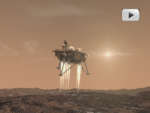 Phoenix Lander Arrives at Mars
25.05.2008
Will Phoenix survive its landing today on Mars? Phoenix's landing sequence will ramp up starting at about 7:30 pm EDT (23:30 UTC) today and last just over an hour. If all goes well, one of Phoenix's first images from Mars will appear on APOD tomorrow.
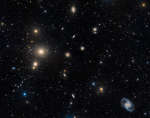 The Fornax Cluster of Galaxies
11.01.2013
How do clusters of galaxies form and evolve? To help find out, astronomers continue to study the second closest cluster of galaxies to Earth: the Fornax cluster, named for the southern constellation toward which most of its galaxies can be found.
 Space Station Robot Forgets Key Again
1.04.2014
Space station robot AFJ013 has forgotten her space lock key again. The frustrated robot was reduced to tapping on a space station window and asking for a human to let her back in -- for the third time this week.
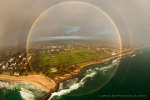 A Full Circle Rainbow over Australia
30.09.2014
Have you ever seen an entire rainbow? From the ground, typically, only the top portion of a rainbow is visible because directions toward the ground have fewer raindrops. From the air, though, the entire 360 degree circle of a rainbow is more commonly visible.
|
January February March April May June July August |
||||||||||||||||||||||||||||||||||||||||||||||||||||||||