
|
You entered: surface
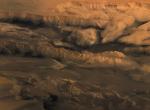 Melas, Candor, and Ophir: Valleys of Mariner
17.02.2005
First imaged by the Mariner 9 spacecraft, Valles Marineris, the grand canyon of Mars, is a system of enormous depressions or chasmas that stretch some 4,000 kilometers along the Martian equator. Looking north over the canyon's central regions, dark Melas Chasma lies in the foreground of this spectacular perspective view.
 Prometheus Remastered
5.04.2010
What does Saturn's shepherd moon Prometheus really look like? The raw images from the robotic Cassini spacecraft's January flyby of the small moon showed tantalizing clues on grainy images, but now that the Cassini team has digitally remastered these images, many more details have come out.
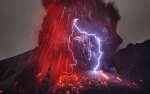 Sakurajima Volcano with Lightning
11.03.2013
Why does a volcanic eruption sometimes create lightning? Pictured above, the Sakurajima volcano in southern Japan was caught erupting in early January. Magma bubbles so hot they glow shoot away as liquid rock bursts through the Earth's surface from below.
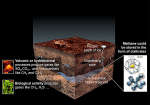 The Mysterious Methane of Mars
21.12.2014
What's creating methane on Mars? Recent measurements from the robotic Curiosity rover currently rolling across Mars indicate a surprising 10-fold increase in atmospheric methane between measurements only months apart. Life is a major...
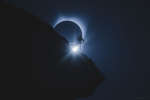 The Climber and the Eclipse
6.09.2017
What should you do if your rock climbing picture is photobombed by a total eclipse of the Sun? Rejoice -- because your planning paid off. After months of considering different venues, and a week...
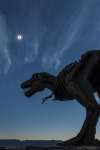 Eclipsosaurus Rex
7.10.2017
We live in an era where total solar eclipses are possible because at times the apparent size of the Moon can just cover the disk of the Sun. But the Moon is slowly moving away from planet Earth. Its distance is measured to increase about 1.5 inches (3.8 centimeters) per year due to tidal friction.
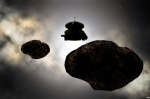 New Horizons at Ultima Thule
29.12.2018
When we celebrate the start of 2019, on January 1 the New Horizons spacecraft will flyby Ultima Thule. A world of the Kuiper belt 6.5 billion kilometers from the Sun, the nickname Ultima Thule (catalog designation 2014 MU69) fittingly means "beyond the known world".
 APOD: 2025 July 30 Б Coronal Loops on the Sun
30.07.2025
Our Sun frequently erupts in loops. Hot solar plasma jumps off the Sun's surface into prominences, with the most common type of prominence being a simple loop. The loop shape originates from the Sun's magnetic field, which is traced by spiraling electrons and protons.
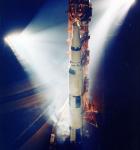 Saturn The Giant
25.05.2001
Forty years ago today (May 25, 1961) U.S. president John Kennedy announced the goal of landing Americans on the Moon by the end of the decade. Kennedy's ambitious speech triggered a nearly unprecedented peacetime technological mobilization and one result was the Saturn V moon rocket.
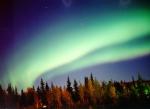 The Secret of the Black Aurora
1.01.2002
What causes black aurora? These gaps in normal bright aurora are frequently recorded but rarely questioned. Recent research using data from four Cluster spacecraft orbiting the Earth has now likely found the secret: black auroras are actually anti-auroras.
|
January February March April May June July August September October |
|||||||||||||||||||||||||||||||||||||||||||||||||