
|
You entered: massive stars
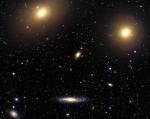 In the Center of the Virgo Cluster
4.08.2003
The Virgo Cluster of Galaxies is the closest cluster of galaxies to our Milky Way Galaxy. The Virgo Cluster is so close that it spans more than 5 degrees on the sky - about 10 times the angle made by a full Moon.
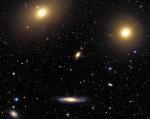 In the Center of the Virgo Cluster
12.02.2005
The Virgo Cluster of Galaxies is the closest cluster of galaxies to our Milky Way Galaxy. The Virgo Cluster is so close that it spans more than 5 degrees on the sky - about 10 times the angle made by a full Moon.
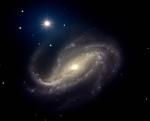 NGC 613: Spiral of Dust and Stars
1.10.2005
When morning twilight came to the Paranal Observatory in Chile, astronomers Mark Neeser and Peter Barthel interrupted their search for faint quasars, billions of light-years away. And just for a moment, they used Very Large Telescopes at the European Southern Observatory to appreciate the beauty of the nearby Universe.
 Leaning Tower, Active Sun
31.03.2022
The natural filter of a hazy atmosphere offered this recognizable architecture and sunset view on March 27. Dark against the solar disk, large sunspots in solar active regions 2975 and 2976 are wedged between the Duomo of Pisa and its famous Leaning Tower.
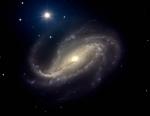 NGC 613: Spiral of Dust and Stars
12.02.2004
When morning twilight came to the Paranal Observatory in Chile, astronomers Mark Neeser and Peter Barthel interrupted their search for faint quasars, billions of light-years away. And just for a moment, they used Very Large Telescopes at the European Southern Observatory to appreciate the beauty of the nearby Universe.
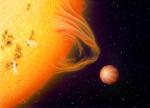 Upsilon Andromedae: An Extra Solar System
16.04.1999
Yesterday, astronomers announced the discovery of the first system of planets around a normal star other than our Sun. Previously, only single planet star systems had been found. Subtle changes in the wobble of Upsilon Andromedae, a Sun-like star in the constellation of Andromeda, allowed astronomers led by R. Paul Butler (AAO) and Geoffrey W.
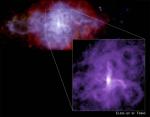 3C58: Pulsar Power
22.12.2004
Light from a star that exploded some ten thousand light-years away first reached our fair planet in the year 1181. Now known as supernova remnant 3C58, the region seen in this false-color image glows in x-rays, powered by a rapidly spinning neutron star or pulsar - the dense remains of the collapsed stellar core.
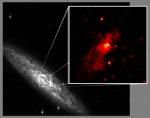 NGC 253: X Ray Zoom
7.06.2001
Astronomers now report that Chandra X-ray Observatory observations of galaxies known to be frantically forming stars show that these galaxies also contain luminous x-ray sources -- thought to be intermediate mass black holes and immense clouds of superheated gas. Take the lovely island universe NGC 253 for example.
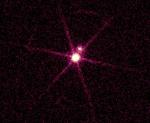 X-Rays From Sirius B
6.10.2000
In visible light Sirius A (Alpha Canis Majoris) is the brightest star in the night sky, a closely watched celestial beacon throughout recorded history. Part of a binary star system only 8 light-years away, it was known in modern times to have a small companion star, Sirius B.
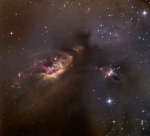 Sh2-239: Celestial Impasto
8.12.2011
The cosmic brush of star formation composed this alluring mix of dust and dark nebulae. Cataloged as Sh2-239 and LDN 1551, the region lies near the southern end of the Taurus molecular cloud complex some 450 light-years distant.
|
January February March April |
|||||||||||||||||||||||||||||||||||||||||||||||||