
|
You entered: color
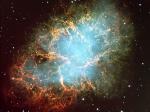 The Crab Nebula from VLT
24.03.2001
The Crab Nebula, filled with mysterious filaments, is the result of a star that was seen to explode in 1054 AD. This spectacular supernova explosion was recorded by Chinese and (quite probably) Anasazi Indian astronomers.
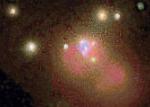 The Center of the Circinus Galaxy in X Rays
16.05.2001
Are black holes the cause of X-rays that pour out from the center of the Circinus galaxy? A new high-resolution image from the orbiting Chandra X-ray Observatory has resolved the inner regions of this nearby galaxy into several smaller sources. The image is shown above in representative-color.
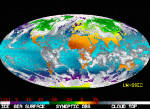 Earth's Temperature
29.01.1997
What's the temperature outside? No matter where you are on Earth, the above map can tell you. This global montage was created using the temperature data from numerous satellites orbiting the Earth. This...
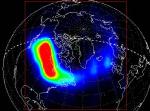 Solar Storm Causes X-Ray Aurora
18.04.1997
On April 7, the SOHO spacecraft spotted a Solar Storm ejecting a cloud of energetic particles toward planet Earth. The plasma cloud's center missed Earth, but high energy particles swept up by Earth's magnetosphere still created a geomagnetic storm!
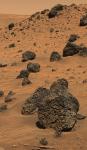 Volcanic Bumpy Boulder on Mars
15.05.2006
What created this unusually textured rock on Mars? Most probably: a volcano. Dubbed Bumpy Boulder, the strange stone measuring just under a half-meter high was found by the robotic Spirit rover currently rolling across Mars.
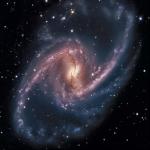 NGC 1365: Majestic Island Universe
28.03.2007
Barred spiral galaxy NGC 1365 is truly a majestic island universe some 200,000 light-years across. Located a mere 60 million light-years away toward the chemical constellation Fornax, NGC 1365 is a dominant member of the well-studied Fornax galaxy cluster.
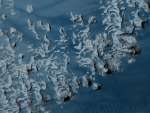 Layers in Aureum Chaos
4.04.2008
At first glance these undulating shapes in shades of blue might look like waves on an ocean. Seen here in a false-color image from the Mars Reconnaissance Orbiter's HiRISE camera, they are actually layered rock outcrops found in Aureum Chaos.
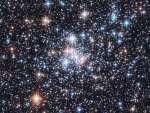 Open Cluster NGC 290: A Stellar Jewel Box
3.08.2008
Jewels don't shine this bright -- only stars do. Like gems in a jewel box, though, the stars of open cluster NGC 290 glitter in a beautiful display of brightness and color. The photogenic cluster, pictured above, was captured recently by the orbiting Hubble Space Telescope.
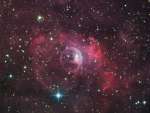 The Bubble Nebula
23.01.2009
Blown by the wind from a massive star, this interstellar apparition has a surprisingly familiar shape. Cataloged as NGC 7635, it is also known simply as The Bubble Nebula. This colorful telescopic image includes a long exposure through a hydrogen alpha filter to reveal details of the cosmic bubble and its environment.
 Rio at Night
20.06.2014
In this night skyscape setting stars trail above the western horizon over Rio de Janeiro, Brazil, a venue for the 2014 World Cup. Gentle arcs from the bright, colorful stars of Orion are near the center of the frame, while the starfield itself straddles planet Earth's celestial equator during the long exposure.
|
January February March April May June July August September October |
|||||||||||||||||||||||||||||||||||||||||||||||||