
|
You entered: massive stars
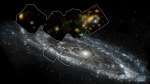 High Energy Andromeda
7.01.2016
A mere 2.5 million light-years away, the Andromeda Galaxy, also known as M31, really is just next door as large galaxies go. In this (inset) scan, image data from NASA's Nuclear Spectrosopic Telescope...
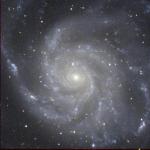 M101: The Pinwheel Galaxy
5.08.1997
Why do many galaxies appear as spirals? A striking example is M101, shown above, whose relatively close distance of about 22 million light years allow it to be studied in some detail. Recent evidence...
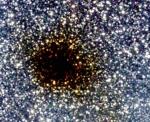 Dark Cloud
26.02.1999
Ominously foreshadowing events to come, a dark cloud of obscuring dust stands out against a luminous star field in the Milky Way. Cataloged as Feitzinger and Stuwe object "1-457" this fuliginous interstellar nebula is relatively close - possibly only 1,000 light-years distant.
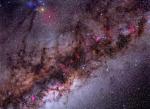 Our Galaxy in Stars, Gas, and Dust
28.09.2003
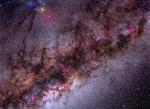
The disk of our Milky Way Galaxy is home to hot nebulae, cold dust, and billions of stars. The red nebulae visible in the above contrast-enhanced picture are primarily emission nebulae, glowing clouds of hydrogen gas heated by nearby, bright, young stars.
 Our Galaxy in Stars, Gas, and Dust
27.09.1999
The disk of our Milky Way Galaxy is home to hot nebulae, cold dust, and billions of stars. The red nebulae visible in the above contrast-enhanced picture are primarily emission nebulae, glowing clouds of hydrogen gas heated by nearby, bright, young stars.
 Irregular Galaxy Sextans A
14.11.1997
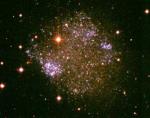
Grand spiral galaxies often seem to get all the glory. Their newly formed, bright, blue star clusters found along beautiful, symmetric spiral arms are guaranteed to attract attention. But small irregular galaxies form stars too, like this lovely, gumdrop-shaped galaxy, Sextans A.
 Irregular Galaxy Sextans A
18.12.1999
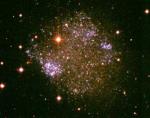
Grand spiral galaxies often seem to get all the glory. Their newly formed, bright, blue star clusters found along beautiful, symmetric spiral arms are guaranteed to attract attention. But small irregular galaxies form stars too, like this lovely, gumdrop-shaped galaxy, Sextans A.
 Super Earths May Circle Other Stars
20.03.2006
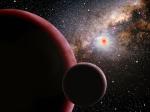
Are "super-Earths" common around other star systems? Quite possibly. Unexpected evidence for this came to light recently when a planet orbiting a distant star gravitationally magnified the light of an even more distant star.
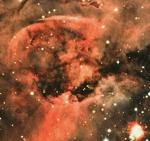 In the Center of the Keyhole Nebula
21.07.1997
Stars, like people, do not always go gentle into that good night. The above Keyhole Nebula results from dying star Eta Carinae's violently casting off dust and gas during its final centuries. Eta Carinae is many times more massive than our own Sun, and should eventually undergo a tremendous supernova explosion.
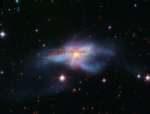 NGC 6240: Merging Galaxies
18.06.2009
NGC 6240 offers a rare glimpse of a cosmic catastrophe in its final throes. The titanic galaxy-galaxy collision is located a mere 400 million light-years away in the constellation Ophiuchus. One of the brightest...
|
January February March April |
|||||||||||||||||||||||||||||||||||||||||||||||||