
|
You entered: young stars
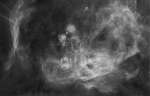 The Gum Nebula Expanse
24.05.2018
Named for a cosmic cloud hunter, Australian astronomer Colin Stanley Gum (1924-1960), The Gum Nebula is so large and close it is actually hard to see. In fact, we are only about 450 light-years from the front edge and 1,500 light-years from the back edge of this interstellar expanse of glowing hydrogen gas.
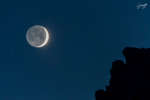 The Bull s Eye and the Young Moon
5.05.2017
Aldebaran, eye of Taurus the Bull, and a young crescent Moon shared an early evening sky last Friday. The lovely celestial pairing could be enjoyed around planet Earth, but from some locations the Moon was even seen to pass in front of Aldebaran, a dramatic lunar occultation of the familiar bright star.
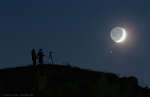 The Hill, The Moon, and Saturn
16.11.2018
Last Sunday when the Moon was young its sunlit crescent hung low near the western horizon at sunset. With strong earthshine it was joined by Saturn shining in the early evening sky for a beautiful conjunction visible to skygazers around our fair planet.
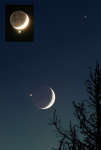 Venus in the Moon
4.12.2008
On December 1, bright planets Venus and Jupiter gathered near the young crescent Moon, an inspiring celestial scene in early evening skies around the world. But from some locations the Moon actually passed in front of Venus, interrupting the tight grouping with a lunar occultation.
 Four Planet Sunset
31.07.2010
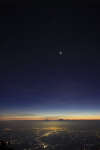
This mesmerizing sunset photo was taken from the summit of volcanic Mount Lawu, 3,265 meters above sea level, on July 21. The view looks west, toward the city lights of Surakarta (aka Solo), Central Java, Indonesia. Two other volcanic peaks, sharp Merapi (left) and Merbabu lie along the colorful horizon.
 APOD: 2023 January 30 Б Globular Star Cluster NGC 6355 from Hubble
30.01.2023
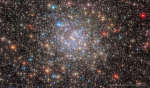
Globular clusters once ruled the Milky Way. Back in the old days, back when our Galaxy first formed, perhaps thousands of globular clusters roamed our Galaxy. Today, there are less than 200 left. Over the eons, many globular clusters were destroyed by repeated fateful encounters with each other or the Galactic center.
 Zooming in on Star Cluster Terzan 5
24.03.2019
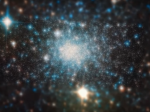
Globular clusters once ruled the Milky Way. Back in the old days, back when our Galaxy first formed, perhaps thousands of globular clusters roamed our Galaxy. Today, there are less than 200 left. Over the eons, many globular clusters were destroyed by repeated fateful encounters with each other or the Galactic center.
 Zooming in on Star Cluster Terzan 5
21.09.2016
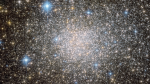
Globular clusters once ruled the Milky Way. Back in the old days, back when our Galaxy first formed, perhaps thousands of globular clusters roamed our Galaxy. Today, there are less than 200 left. Over the eons, many globular clusters were destroyed by repeated fateful encounters with each other or the Galactic center.
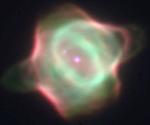 Hen 1357: New Born Nebula
3.04.1998
This Hubble Space Telescope picture shows Hen-1357, the youngest known planetary nebula. Graceful, gentle curves and symmetry suggest its popular name - The Stingray Nebula. Observations in the 1970s detected no nebular material, but this image from March 1996 clearly shows the Stingray's emerging bubbles and rings of shocked and ionized gas.
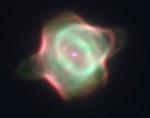 Hen 1357: New Born Nebula
6.10.2001
This Hubble Space Telescope snapshot shows Hen-1357, the youngest known planetary nebula. Graceful, gentle curves and symmetry suggest its popular name - The Stingray Nebula. Observations in the 1970s detected no nebular material, but this image from March 1996 clearly shows the Stingray's emerging bubbles and rings of shocked and ionized gas.
|
January February March April May June July August September October |
|||||||||||||||||||||||||||||||||||||||||||||||||