
|
You entered: dust cloud
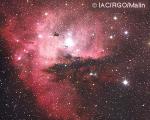 NGC 281: Cluster, Clouds, and Globules
21.09.1998
NGC 281 is a busy workshop of star formation. Prominent features include a small open cluster of stars, a diffuse red-glowing emission nebula, large lanes of obscuring gas and dust, and dense knots of dust and gas in which stars may still be forming.
 Portrait of NGC 281
27.11.2014
Look through the cosmic cloud cataloged as NGC 281 and you might miss the stars of open cluster IC 1590. But, formed within the nebula, that cluster's young, massive stars ultimately power the pervasive nebular glow.
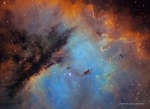 Portrait of NGC 281
29.09.2017
Look through the cosmic cloud cataloged as NGC 281 and you might miss the stars of open cluster IC 1590. Still, formed within the nebula that cluster's young, massive stars ultimately power the pervasive nebular glow.
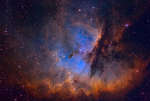 Portrait of NGC 281
3.11.2016
Look through the cosmic cloud cataloged as NGC 281 and you might miss the stars of open cluster IC 1590. Still, formed within the nebula that cluster's young, massive stars ultimately power the pervasive nebular glow.
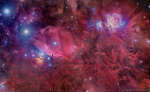 Orion in Gas, Dust, and Stars
10.11.2014
The constellation of Orion holds much more than three stars in a row. A deep exposure shows everything from dark nebula to star clusters, all embedded in an extended patch of gaseous wisps in the greater Orion Molecular Cloud Complex.
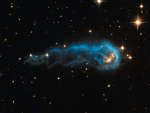 IRAS 20324: Evaporating Protostar
4.09.2013
Will this caterpillar-shaped interstellar cloud one day evolve into a butterfly-shaped nebula? No one is sure. What is sure is that IRAS 20324+4057, on the inside, is contracting to form a new star.
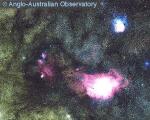 The Sky Towards Sagittarius
7.09.1998
A variety of stars and nebulae can be found towards the constellation of Sagittarius. Dense fields of stars laced with dark lanes of dust crowd this region only a few degrees from the center of our Galaxy.
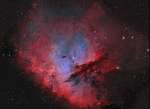 Portrait of NGC 281
25.08.2011
Look through the cosmic cloud cataloged as NGC 281 and it's almost easy to miss stars of open cluster IC 1590. But, formed within the nebula, that cluster's young, massive stars ultimately power the pervasive nebular glow.
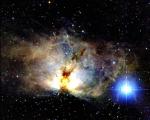 The Flame Nebula in Infrared
13.07.1999
What lights up the Flame Nebula? Fifteen hundred light years away towards the constellation of Orion lies a nebula which, from its glow and dark dust lanes, appears like a billowing fire. But fire, the rapid acquisition of oxygen, is not what makes this Flame glow.
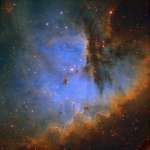 NGC 281
9.12.2008
Look through the cosmic cloud cataloged as NGC 281 and it's almost easy to miss stars of the open cluster IC 1590. But, formed within the nebula, that cluster's young, massive stars ultimately power the pervasive nebular glow.
|
January February March April May June July August September |
|||||||||||||||||||||||||||||||||||||||||||||||||