
|
You entered: telescope
 Comet Between Fireworks and Lightning
10.11.2013
Sometimes the sky itself is the best show in town. In January 2007, people from Perth, Australia gathered on a local beach to watch a sky light up with delights near and far. Nearby, fireworks exploded as part of Australia Day celebrations. On the far right, lightning from a thunderstorm flashed in the distance.
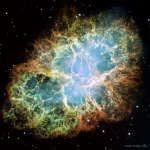 M1: The Crab Nebula from Hubble
15.08.2015
This is the mess that is left when a star explodes. The Crab Nebula, the result of a supernova seen in mysterious filaments. The filaments are not only tremendously complex, but appear to have less mass than expelled in the original supernova and a higher speed than expected from a free explosion.
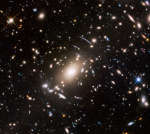 Galaxy Cluster Abell S1063 and Beyond
21.07.2016
Some 4 billion light-years away, galaxies of massive Abell S1063 cluster near the center of this sharp Hubble Space Telescope snapshot. But the fainter bluish arcs are magnified images of galaxies that lie far beyond Abell S1063.
 APOD: 2023 April 8 Б M100: A Grand Design Spiral Galaxy
7.04.2023
Majestic on a truly cosmic scale, M100 is appropriately known as a grand design spiral galaxy. It is a large galaxy of over 100 billion stars with well-defined spiral arms that is similar to our own Milky Way Galaxy.
 Ghirigori Star Scribbles
11.08.2023
It's fun to scribble on the canvas of the sky. You can use a creative photographic technique to cause the light of point-like stars to dance across a digital image by tapping lightly on the telescope while making an exposure.
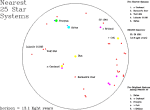 The Nearest Stars
17.03.2001
Which stars are closest to the Sun? The closest is Proxima Centauri, one of three stars that orbit each other about 4 light-years away in the Alpha-Centauri system. Alpha Centauri is easily visible from Earth's
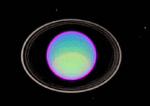 Uranus' Ring System
30.04.1996
The rings of Uranus are thin, narrow, and dark compared to other planetary ring systems. Brightened artificially by computer, the ring particles reflect as little light as charcoal, although they are really made of ice chucks darkened by rock.
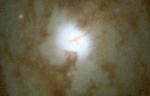 In the Center of the Whirlpool
25.04.1996
In the center of M51, a spiral galaxy 23 million light-years away, astronomers have identified a dense region of young stars. The graceful swirling arcs of this galaxy's spiral arms have inspired its popular name, "The Whirlpool Galaxy".
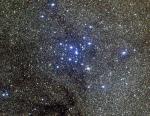 The M7 Open Star Cluster in Scorpius
21.02.2004
M7 is one of the most prominent open clusters of stars on the sky. The cluster, dominated by bright blue stars, can be seen with the naked eye in a dark sky in the tail of the constellation of Scorpius.
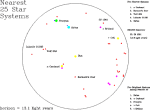 The Nearest Stars
21.04.1999
Which stars are closest to the Sun? The closest is Proxima Centauri, one of three stars that orbit each other about 4 light-years away in the Alpha-Centauri system. Alpha Centauri is easily visible from Earth's Southern Hemisphere. Next is Barnard's Star, a dim star visible with a telescope in the constellation of Ophiuchus.
|
January February March April May June July August September October |
|||||||||||||||||||||||||||||||||||||||||||||||||