
|
You entered: Milky Way
 LEDA 1313424: The Bullseye Galaxy
7.02.2025
The giant galaxy cataloged as LEDA 1313424 is about two and a half times the size of our own Milky Way. Its remarkable appearance in this recently released Hubble Space Telescope image strongly suggests its nickname "The Bullseye Galaxy".
 APOD: 2025 September 19 Б The NGC 6914 Complex
19.09.2025
A study in contrasts, this colorful cosmic skyscape features stars, dust, and glowing gas in the vicinity of NGC 6914. The interstellar complex of nebulae lies some 6,000 light-years away, toward the high-flying northern constellation Cygnus and the plane of our Milky Way Galaxy.
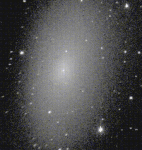 Local Group Galaxy NGC 205
8.01.1996
The Milky Way Galaxy is not alone. It is part of a gathering of about 25 galaxies known as the Local Group. Members include the Great Andromeda Galaxy (M31), M32, M33, the Large Magellanic Clouds, the Small Magellanic Clouds, Dwingeloo 1, several small irregular galaxies, and many dwarf elliptical galaxies.
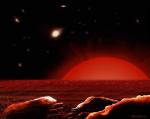 Stars Without Galaxies
15.02.1998
Galaxies are made up of stars, but are all stars found within galaxies? Using the Hubble Space Telescope, researchers exploring the Virgo Cluster of galaxies have now found about 600 red giant stars adrift in intergalactic space. Above is an artist's vision of the sky from a hypothetical planet of such a lonely sun.
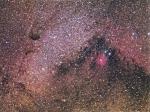 M24: A Sagittarius Starscape
21.09.2004
Many vast star fields in the plane of our Milky Way Galaxy are rich in clouds of dust, and gas. First and foremost, visible in the above picture are millions of stars, many of which are similar to our Sun.
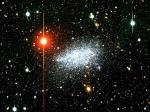 Leo A: Nearby Dwarf Irregular Galaxy
10.11.2004
Why isn't this small galaxy simple? The above image and contemporary observations of small nearby galaxy Leo A were supposed to show it has a simple structure. Now Leo A is known...
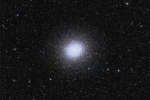 Omega Centauri: The Largest Globular Cluster Known
1.03.2009
This huge ball of stars predates our Sun. Long before humankind evolved, before dinosaurs roamed, and even before our Earth existed, ancient globs of stars condensed and orbited a young Milky Way Galaxy. Of the 200 or so globular clusters that survive today, Omega Centauri is the largest, containing over ten million stars.
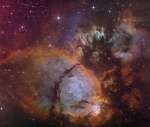 The Colors of IC 1795
10.12.2009
This colorful cosmic portrait features glowing gas and dark dust clouds in IC 1795, a star forming region in the northern constellation Cassiopeia. The nebula's colors were created by adopting the Hubble false-color...
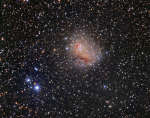 Starburst Galaxy IC 10
4.01.2012
Lurking behind dust and stars near the plane of our Milky Way Galaxy, IC 10 is a mere 2.3 million light-years distant. Even though its light is dimmed by intervening dust, the irregular dwarf galaxy still shows off vigorous star-forming regions that shine with a telltale reddish glow in this colorful skyscape.
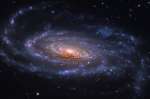 Spiral Galaxy NGC 5033
17.08.2012
Magnificent island universe NGC 5033 lies some 40 million light-years away in the well-trained northern constellation Canes Venatici. This telescopic portrait reveals striking details of dust lanes winding near the galaxy's bright core and majestic but relatively faint spiral arms.
|
January February March April May June July August September October |
|||||||||||||||||||||||||||||||||||||||||||||||||