
|
You entered: Solar System
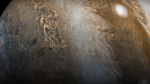 Perijove 11: Passing Jupiter
28.08.2022
Here comes Jupiter! NASA's robotic spacecraft Juno is continuing on its highly-elongated orbits around our Solar System's largest planet. The featured video is from perijove 11 in early 2018, the eleventh time Juno has passed near Jupiter since it arrived in mid-2016.
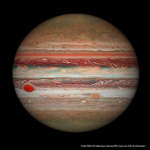 Hubbles Jupiter and the Shrinking Great Red Spot
9.01.2022
What will become of Jupiter's Great Red Spot? Gas giant Jupiter is the solar system's largest world with about 320 times the mass of planet Earth. Jupiter is home to one of the largest and longest lasting storm systems known, the Great Red Spot (GRS), visible to the left.
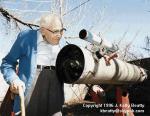 Clyde W. Tombaugh: 1906-1997
4.02.1997
Astronomer Clyde Tombaugh, discoverer of Pluto, died on January 17th. Inspiring many during his long and exceptional career, he had been living in Las Cruces, New Mexico with his wife of 60 years, Patsy. Today would have been his 91st birthday.
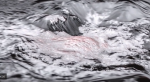 Salt Water Remnants on Ceres
1.09.2020
Does Ceres have underground pockets of water? Ceres, the largest asteroid in the asteroid belt, was thought to be composed of rock and ice. At the same time, Ceres was known to have unusual bright spots on its surface. These bright spots were clearly imaged during Dawn's exciting approach in 2015.
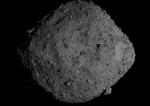 Descending Toward Asteroid Bennu
12.10.2020
What would it be like to land on an asteroid? Although no human has yet done it, NASA's robotic OSIRIS-REx spacecraft is scheduled to attempt to touch the surface of asteroid 101955 Bennu next week.
 APOD: 2025 May 11 Б The Surface of Venus from Venera 14
11.05.2025
If you could stand on Venus -- what would you see? Pictured is the view from Venera 14, a robotic Soviet lander which parachuted and air-braked down through the thick Venusian atmosphere in March of 1982.
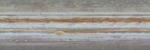 Jupiter Unpeeled
15.02.2001
Slice Jupiter from pole to pole, peel back its outer layers of clouds, stretch them onto a flat surface ... and for all your trouble you'd end up with something that looks a lot like this. Scrolling right will reveal the full picture, a color mosaic of Jupiter from the Cassini spacecraft.
 Jupiter and Saturn Pas de Deux
20.12.2001
Viewed from Earth, the solar system's planets do a cosmic dance that is hard to appreciate on any single night. But consider this well planned animated sequence combining 23 pictures taken at approximately 2 week intervals from June 2000 through May 2001.
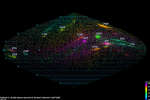 Forty Thousand Meteor Origins Across the Sky
11.05.2009
Where do meteors come from? Visible meteors are typically sand-sized grains of ice and rock that once fragmented from comets. Many a meteor shower has been associated with a known comet, although some intriguing orphan showers do remain.
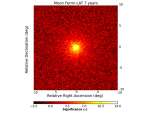 Fermi s Gamma-ray Moon
29.04.2016
If you could only see gamma-rays, photons with up to a billion or more times the energy of visible light, the Moon would be brighter than the Sun! That startling notion underlies this novel...
|
January February March April May June July August September |
|||||||||||||||||||||||||||||||||||||||||||||||||