
|
You entered: nearest stars
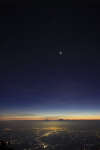 Four Planet Sunset
31.07.2010
This mesmerizing sunset photo was taken from the summit of volcanic Mount Lawu, 3,265 meters above sea level, on July 21. The view looks west, toward the city lights of Surakarta (aka Solo), Central Java, Indonesia. Two other volcanic peaks, sharp Merapi (left) and Merbabu lie along the colorful horizon.
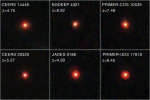 APOD: 2025 December 24 Б Mystery: Little Red Dots in the Early Universe
23.12.2025
What are these little red dots (LRDs)? Nobody knows. Discovered only last year, hundreds of LRDs have now been found by the James Webb Space Telescope in the early universe. Although extremely faint, LRDs are now frequently identified in deep observations made for other purposes.
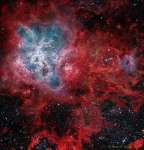 The Cosmic Web of the Tarantula Nebula
7.11.2016
It is the largest and most complex star forming region in the entire galactic neighborhood. Located in the Large Magellanic Cloud, a small satellite galaxy orbiting our Milky Way galaxy, the region's spidery appearance is responsible for its popular name, the Tarantula nebula. This tarantula, however, is about 1,000 light-years across.
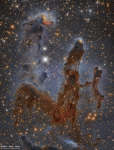 APOD: 2026 May 31 Б Eagle Nebula Pillars in Infrared from Hubble
30.05.2026
Newborn stars are forming in the Eagle Nebula. They are gravitationally contracting in pillars of dense gas and dust. The intense radiation of these newly-formed bright stars is causing surrounding material to boil away.
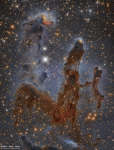 Pillars of the Eagle Nebula in Infrared
19.06.2018
Newborn stars are forming in the Eagle Nebula. Gravitationally contracting in pillars of dense gas and dust, the intense radiation of these newly-formed bright stars is causing surrounding material to boil away. This image...
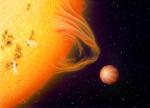 Upsilon Andromedae: An Extra Solar System
16.04.1999
Yesterday, astronomers announced the discovery of the first system of planets around a normal star other than our Sun. Previously, only single planet star systems had been found. Subtle changes in the wobble of Upsilon Andromedae, a Sun-like star in the constellation of Andromeda, allowed astronomers led by R. Paul Butler (AAO) and Geoffrey W.
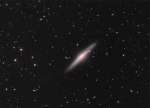 NGC 2683: Edge On Spiral Galaxy
17.03.2012
This elegant island universe is cataloged as NGC 2683. It lies a mere 16 million light-years distant toward the northern constellation Lynx. A spiral galaxy comparable to our own Milky Way, NGC 2683 is seen nearly edge-on in the cosmic vista.
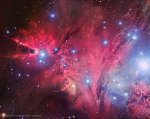 A Fox Fur, a Unicorn, and a Christmas Tree
4.01.2015
What do the following things have in common: a cone, the fur of a fox, and a Christmas tree? Answer: they all occur in the constellation of the unicorn (Monoceros). Pictured as a star...
 HD70642: A Star with Similar Planets
9.07.2003
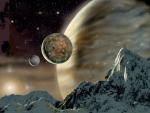
Astronomers have discovered a planetary system more similar to our own Solar System than any known previously. The bright star HD70642, visible with binoculars toward the constellation of Puppis, was already known to be a star like our Sun.
 The Crab Nebula in X Rays
29.09.1999
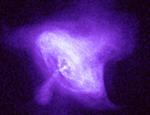
Why does the Crab Nebula still glow? In the year 1054 A.D. a supernova was observed that left a nebula that even today glows brightly in every color possible, across the entire electromagnetic spectrum. At the nebula's center is an ultra-dense neutron star that rotates 30 times a second.
|
January February March April May June July August September |
|||||||||||||||||||||||||||||||||||||||||||||||||