
|
You entered: Earth's moon
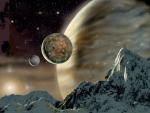 HD70642: A Star with Similar Planets
9.07.2003
Astronomers have discovered a planetary system more similar to our own Solar System than any known previously. The bright star HD70642, visible with binoculars toward the constellation of Puppis, was already known to be a star like our Sun.
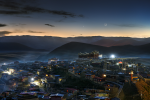 Moon and Planets at Twilight
27.11.2019
This week's ongoing conjunction of Venus and Jupiter may have whetted your appetite for skygazing. Tonight is the main course though. On November 28, a young crescent Moon will join them posing next to the two bright planets above the western horizon at twilight.
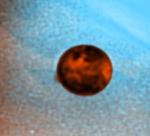 Eruption on Io
23.06.1997
There it goes again. Gas and rock were catapulted hundreds of kilometers into space as Jupiter's most volatile moon, Io, showed yet another impressive volcanic display in this just-released photograph by the Hubble Space Telescope.
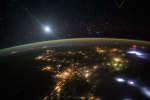 Sprites from Space
20.08.2015
An old Moon and the stars of Orion rose above the eastern horizon on August 10. The Moon's waning crescent was still bright enough to be overexposed in this snapshot taken from another large satellite of planet Earth, the International Space Station.
 Jupiter, Moons, and Bees
25.09.2002
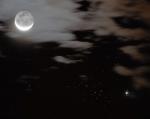
Rising before the Sun on September 4, Jupiter and an old cresent Moon gathered in the dim constellation of Cancer. Watching from a hillside near Austin, Texas, planet Earth, astrophotographer Russell Croman recorded this view of their passing as clouds gracefully dimmed the brilliant moonlight.
 Leonids Over Monument Valley
14.11.2015
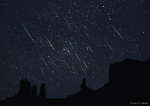
There was a shower over Monument Valley -- but not water. Meteors. The featured image -- actually a composite of six exposures of about 30 seconds each -- was taken in 2001, a year when there was a very active Leonids shower.
 Water Discovered in Moon Shadow
17.11.2009
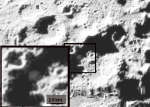
Why is there water on the Moon? Last month, the LCROSS mission crashed a large impactor into a permanently shadowed crater near the Moon's South Pole. A plume of dust rose that was visible to the satellite, although hard to discern from Earth. The plume is shown above in visible light.
 Jupiter's Dry Spots
12.06.1997
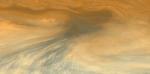
Known for its spectacular images of Jupiter's moons, Io, Ganymede, Callisto, and Europa, the robot spacecraft Galileo has also aggressively explored the Jovian atmosphere. In December of 1995, Galileo's atmospheric probe descended into Jupiter's clouds and reported a surprising absence of water.
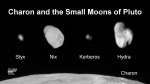 Charon and the Small Moons of Pluto
25.10.2015
What do the moons of Pluto look like? Before a decade ago, only the largest moon Charon was known, but never imaged. As the robotic New Horizons spacecraft was prepared and launched, other moons were identified on Hubble images but remained only specks of light.
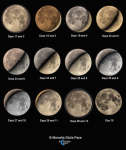 Moon Pairs and the Synodic Month
25.09.2020
Observe the Moon each night and its visible sunlit portion will gradually change. In phases progressing from New Moon to Full Moon to New Moon again, a lunar cycle or synodic month is completed in about 29.5 days.
|
January February March April May June July August September |
|||||||||||||||||||||||||||||||||||||||||||||||||