
|
You entered: Earth orbit
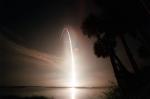 Atlantis to Orbit
12.12.2004
Birds don't fly this high. Airplanes don't go this fast. The Statue of Liberty weighs less. No species other than human can even comprehend what is going on, nor could any human just a millennium ago. The launch of a rocket bound for space is an event that inspires awe and challenges description.
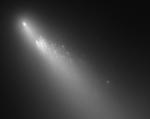 Schwassmann Wachmann 3: Fragment B
4.05.2006
Periodic comet 73P/Schwassmann-Wachmann 3 has fallen apart before. A cosmic souffle of ice and dust left over from the early solar system, this comet was seen to split into several large pieces during the close-in part of its orbit in 1995.
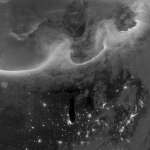 Aurorae over Planet Earth
11.10.2012
North America at night is easy to recognize in this view of our fair planet from orbit, acquired by the Suomi-NPP satellite on October 8. The spectacular waves of visible light emission rolling above the Canadian provinces of Quebec and Ontario in the upper half of the frame are the Aurora Borealis or northern lights.
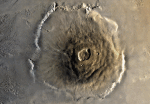 The Mountains of Mars
19.07.1995
Volcanic activity on Mars has produced towering mountains. The largest one, Olympus Mons, is pictured here in this Viking Orbiter image. Olympus Mons is a shield volcano nearly 15 miles high and over 300 miles wide at its base.
 Mars in the New Year
6.01.2000
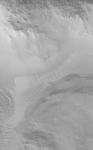
Many will long remember where they were and what they were doing when the calendar rolled over to the year 2000. On Mars, of course, that date was nothing special and the Mars Global Surveyor spacecraft continued with business as usual - systematically recording images of the Red Planet from orbit.
 Planet Aurora
26.06.2015
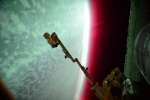
What bizarre alien planet is this ? It's planet Earth of course, seen through the shimmering glow of aurorae from the International Space Station. About 400 kilometers (250 miles) above, the orbiting station is itself within the upper realm of the auroral displays, also watched from the planet's surface on June 23rd.
 Northern Summer on Titan
20.06.2020
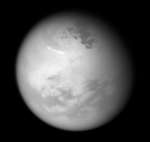
Today's solstice brings summer to planet Earth's northern hemisphere. But the northern summer solstice arrived for ringed planet Saturn over three years ago on May 24, 2017. Orbiting the gas giant, Saturn's moon Titan experiences the Saturnian seasons.
 3D Face on Mars
21.04.2007
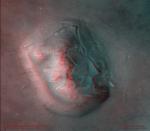
Get out your red/blue glasses and gaze down on this weathered mesa on Mars. Of course, described as a rock formation which resembles a human head in a 1976 NASA press release, this mesa is also famous as the Face on Mars.
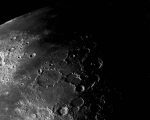 A Violet Moon
31.07.1996
Checking out the Galileo spacecraft's cameras during its December 1992 flyby of Earth's Moon, controllers took this dramatically illuminated picture through a violet filter. The view looks down on the Moon...
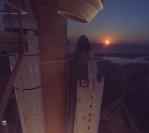 Discovery Spring
20.03.2001
Welcome to the equinox! Moving northward in Earth's sky, today the Sun crosses the celestial equator at 13:31 Universal Time bringing Spring to the north and Fall to the south. The change...
|
January February March April May June July August September October |
|||||||||||||||||||||||||||||||||||||||||||||||||