
|
You entered: space
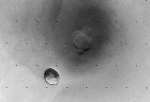 Phobos Over Mars
15.10.1996
Hurtling through space a mere 3,000 miles above the Martian surface, the diminutive moon Phobos (below and left of center) was imaged against the backdrop of a large shield volcano by the Viking 2 Orbiter in 1977.
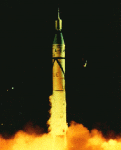 The First Explorer
18.05.1997
The first US spacecraft was Explorer 1. The cylindrical 30 pound satellite was launched (above) as the fourth stage of a Jupiter-C rocket (a modified US Army Redstone ballistic missile) and achieved orbit on January 31, 1958.
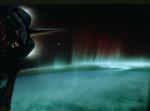 Southern Lights and Shuttle Glow
22.02.1998
A background of distant stars, sinuous and spiky bands of Southern Lights (Aurora Australis), and the faint glow of charged plasma (ionized atomic gas) surrounding the Space Shuttle Discovery's engines give this photo from the STS-39 mission an eerie, otherworldly look.
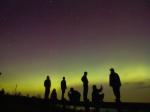 Contemplating the Sky
8.08.2004
Have you contemplated your sky recently? This week will be a good one for midnight meditators at many northerly locations as meteors from the Perseid meteor shower will frequently streaked through. The Perseid meteor shower has slowly been building to a crescendo and should peak on the nights of August 11 and 12.
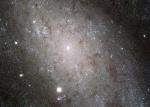 The Stars of NGC 300
20.08.2005
Like grains of sand on a cosmic beach, individual stars of large spiral galaxy NGC 300 are resolved in this sharp image from the Hubble Space Telescope's Advanced Camera for Surveys (ACS). The inner region of the galaxy is pictured, spanning about 7,500 light-years.
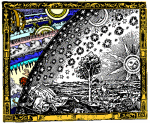 The Millennium that Defines Universe
1.01.2000
Welcome to the millennial year at the threshold of millennium three. During millennium two, humanity continually redefined its concept of "Universe": first as spheres centered on the Earth, in mid-millennium as the Solar System, a few centuries ago as the Galaxy, and within the last century as the matter emanating from the Big Bang.
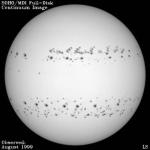 Follow The Spots
21.10.1999
The Sun rotates on its axis about once every 27 days. How can you tell? Just follow the sunspots. This composite picture was constructed from solar images recorded daily by the MDI instrument on board the space-based SOlar and Heliospheric Observatory (SOHO).
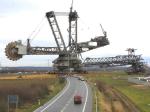 A Bucket Wheel Excavator on Earth
22.11.2006
Please wait while one of the largest mobile machines in the world crosses the road. The machine pictured above is a bucket-wheel excavator used in modern surface mining. Machines like this have given humanity the ability to mine minerals and change the face of planet Earth in new and dramatic ways.
 Dragon over Central Park
5.06.2020
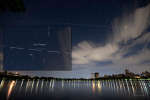
Still bathed in sunlight the International Space Station (ISS) arced through this Manhattan evening sky on May 30. Moving left to right, its bright trail was captured in this composite image with a series of 5 second long exposures.
 Jets from the Necklace Nebula
18.05.2021
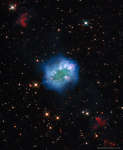
What celestial body wears the Necklace Nebula? First, analyses indicate that the Necklace is a planetary nebula, a gas cloud emitted by a star toward the end of its life. Also, what appears to be diamonds in the Necklace are actually bright knots of glowing gas.
|
January February March April May June July August September October |
|||||||||||||||||||||||||||||||||||||||||||||||||