
|
You entered: Solar System
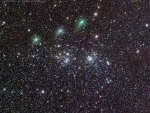 Two Custers and a Comet
30.01.2020
This lovely starfield spans some four full moons (about 2 degrees) across the heroic northern constellation of Perseus. In telescopic exposures made during the nights of January 24, 26, and 28 it holds...
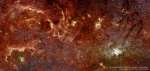 The Galactic Core in Infrared
17.01.2015
What's happening at the center of our Milky Way Galaxy? To help find out, the orbiting Hubble and Spitzer space telescopes have combined their efforts to survey the region in unprecedented detail in infrared light. Milky Way's center because visible light is more greatly obscured by dust.
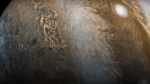 Passing Jupiter
26.02.2018
Here comes Jupiter! NASA's robotic spacecraft Juno is continuing on its 53-day, highly-elongated orbits around our Solar System's largest planet. The featured video is from perijove 11, the eleventh time Juno has passed near Jupiter since it arrived in mid-2016.
 Comet Tsuchinshan ATLAS Flys Away
19.10.2024
These six panels follow daily apparitions of comet C/2023 A3 Tsuchinshan-ATLAS as it moved away from our fair planet during the past week. The images were taken with the same camera and lens at the indicated dates and locations from California, planet Earth.
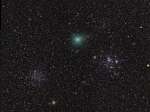 Hartley 2 Star Cluster Tour
2.12.2010
Early in November, small but active Comet Hartley 2 (103/P Hartley) became the fifth comet imaged close-up by a spacecraft from planet Earth. Continuing its own tour of the solar system with a 6 year orbital period, Hartley 2 is now appearing in the nautical constellation Puppis.
 Neptune: Once Around
14.07.2011
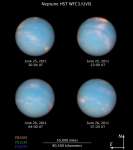
Neptune rotates once on its axis in about 16 hours. So, spaced about 4 hours apart these 4 images of the solar system's most distant gas giant cover one Neptune day. Recorded...
 Southern Cross over Chilean Volcano
25.01.2021
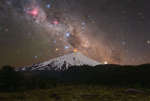
Have you ever seen the Southern Cross? This famous four-star icon is best seen from Earth's Southern Hemisphere. The featured image was taken last month in Chile and captures the Southern Cross just to the left of erupting Villarrica, one of the most active volcanos in our Solar System.
 The Complex Ion Tail of Comet Lovejoy
20.01.2015
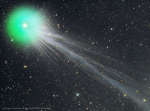
What causes the structure in Comet Lovejoy's tail? Comet C/2014 Q2 (Lovejoy), which is currently at naked-eye brightness and near its brightest, has been showing an exquisitely detailed ion tail. As the name...
 M44: The Beehive Cluster
30.04.2022
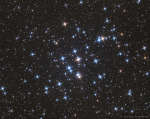
A mere 600 light-years away, M44 is one of the closest star clusters to our solar system. Also known as the Praesepe or the Beehive cluster its stars are young though, about 600 million years old compared to our Sun's 4.5 billion years.
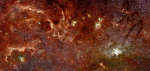 The Galactic Core in Infrared
7.01.2009
What's happening at the center of our Milky Way Galaxy? To help find out, the orbiting Hubble and Spitzer space telescopes have combined their efforts to survey the region in unprecedented detail in infrared light.
|
January February March April May June July August September |
|||||||||||||||||||||||||||||||||||||||||||||||||