
|
You entered: Elliptical Galaxy
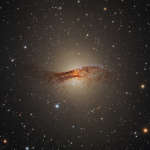 Centaurus A
12.07.2018
Only 11 million light-years away, Centaurus A is the closest active galaxy to planet Earth. Spanning over 60,000 light-years, the peculiar elliptical galaxy also known as NGC 5128, is featured in this sharp telescopic view.
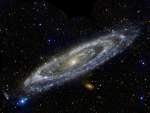 GALEX: The Andromeda Galaxy
18.05.2012
A mere 2.5 million light-years away, the Andromeda Galaxy really is just next door as large galaxy's go. So close, and spanning some 260,000 light-years, it took 11 different image fields from the Galaxy Evolution Explorer (GALEX) satellite's telescope to produce this gorgeous portrait of the spiral galaxy in ultraviolet light.
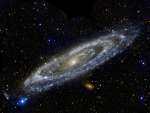 Ultraviolet Rings of M31
24.07.2015
A mere 2.5 million light-years away the Andromeda Galaxy, also known as M31, really is just next door as large galaxies go. So close and spanning some 260,000 light-years, it took 11 different...
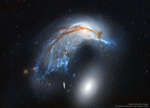 The Porpoise Galaxy from Hubble
10.05.2020
What's happening to this spiral galaxy? Just a few hundred million years ago, NGC 2936, the upper of the two large galaxies shown, was likely a normal spiral galaxy -- spinning, creating stars -- and minding its own business.
 3C 295: X-rays From A Giant Galaxy
25.11.1999
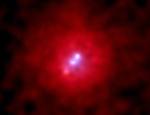
Did this galaxy eat too much? Five billion light-years away, the giant elliptical galaxy 3C295 is a prodigious source of energy at radio wavelengths. Bright knots of X-ray emission are also seen at the center of this false-color Chandra Observatory image of the region.
 Galaxy Cluster Abell 370 and Beyond
6.05.2017
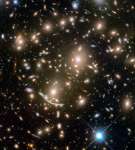
Some 4 billion light-years away, massive galaxy cluster Abell 370 only appears to be dominated by two giant elliptical galaxies and infested with faint arcs in this sharp Hubble Space Telescope snapshot. The fainter...
 The Porpoise Galaxy from Hubble
6.02.2017
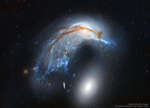
What's happening to this spiral galaxy? Just a few hundred million years ago, NGC 2936, the upper of the two large galaxies shown, was likely a normal spiral galaxy -- spinning, creating stars -- and minding its own business.
 Centaurus A
9.03.2017
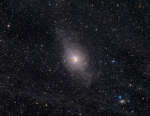
Only 11 million light-years away, Centaurus A is the closest active galaxy to planet Earth. Spanning over 60,000 light-years, the peculiar elliptical galaxy also known as NGC 5128, is featured in this sharp telescopic view.
 APOD: 2025 April 21 Б Galaxy Lenses Galaxy from Webb
21.04.2025
Is this one galaxy or two? Although it looks like one, the answer is two. One path to this happening is when a small galaxy collides with a larger galaxy and ends up in the center. But in the featured image, something more rare is going on.
 Jumbled Galaxy Centaurus A
30.06.2007
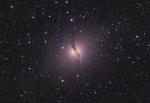
At the center of this sharp skyscape, Centaurus A seems to be a fantastic jumble of old yellow stars, young blue star clusters, and imposing dark dust lanes. Spanning over 60,000 light-years, the peculiar elliptical galaxy is apparently the result of a collision of two otherwise normal galaxies.
|
January February March April May June July August September |
|||||||||||||||||||||||||||||||||||||||||||||||||