
|
You entered: Orion Nebula
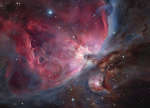 At the Heart of Orion
1.01.2015
Near the center of this sharp cosmic portrait, at the heart of the Orion Nebula, are four hot, massive stars known as the Trapezium. Tightly gathered within a region about 1.5 light-years in radius, they dominate the core of the dense Orion Nebula Star Cluster.
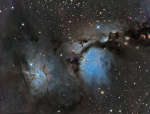 M78 and Reflecting Dust Clouds
26.03.2014
An eerie blue glow and ominous columns of dark dust highlight M78 and other bright reflection nebula in the constellation of Orion. The dark filamentary dust not only absorbs light, but also reflects the light of several bright blue stars that formed recently in the nebula.
 Trapezium: At the Heart of Orion
5.01.2024
Near the center of this sharp cosmic portrait, at the heart of the Orion Nebula, are four hot, massive stars known as the Trapezium. Gathered within a region about 1.5 light-years in radius, they dominate the core of the dense Orion Nebula Star Cluster.
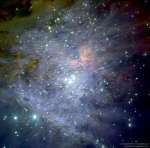 Magnetic Orion
27.02.2019
Can magnetism affect how stars form? Recent analysis of Orion data from the HAWC+ instrument on the airborne SOFIA observatory indicate that, at times, it can. HAWC+ is able to measure the polarization of far-infrared light which can reveal the alignment of dust grains by expansive ambient magnetic fields.
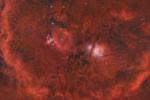 Orion s Cradle
25.01.2007
Cradled in glowing hydrogen, stellar nurseries in Orion lie at the edge of a giant molecular cloud some 1,500 light-years away. This breath-taking view spans about 13 degrees across the center of the well-known constellation with the Great Orion Nebula, the closest large star forming region, just right of center.
 Orion Arising
28.06.2014
Orion's belt runs just along the horizon, seen through Earth's atmosphere and rising in this starry snapshot from low Earth orbit on board the International Space Station. The belt stars, Alnitak, Alnilam...
 In the Center of the Trapezium
18.11.1997
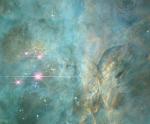
Start with the constellation of Orion. Below Orion's belt is a fuzzy area known as the Great Nebula of Orion or M42. In this nebula is a bright star cluster known as the Trapezium, shown above. New stellar systems are forming there in gigantic globs of gas and dust known as Proplyds.
 At the Heart of Orion
12.03.2017
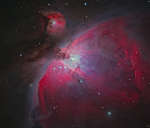
Near the center of this sharp cosmic portrait, at the heart of the Orion Nebula, are four hot, massive stars known as the Trapezium. Tightly gathered within a region about 1.5 light-years in radius, they dominate the core of the dense Orion Nebula Star Cluster.
 In the Center of the Trapezium
2.03.2003
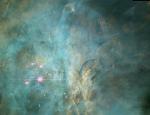
Start with the constellation of Orion. Near Orion's belt is a fuzzy area known as the Great Nebula of Orion or M42. In this nebula is a bright star cluster known as the Trapezium, shown above. New stellar systems are forming there in gigantic globs of gas and dust known as Proplyds.
 At the Heart of Orion
6.10.2012
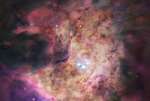
Near the center of this sharp cosmic portrait, at the heart of the Orion Nebula, are four hot, massive stars known as the Trapezium. Gathered within a region about 1.5 light-years in radius, they dominate the core of the dense Orion Nebula Star Cluster.
|
January February March April May June July August September October |
|||||||||||||||||||||||||||||||||||||||||||||||||