
|
You entered: comet nucleus
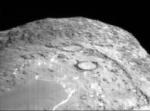 The Landscape on Comet Tempel 1
6.07.2005
This diverse landscape is the surface of comet Temple 1's nucleus as seen by the Deep Impact probe's Impactor Targeting Sensor. Within minutes of recording the rugged view, the landscape had changed dramatically though, as the impactor smashed into the surface near the two large, half kilometer-sized craters at picture center.
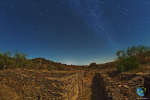 Draconid Meteors Over Spain
19.10.2011
What are those streaks in the sky? They're meteors from the Draconids meteor shower that peaked earlier this month. The above composite image captured numerous meteor streaks over 90 minutes above the Celtic ruins of Capote in Badajoz province, Spain.
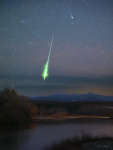 The Comet and the Fireball
20.12.2021
This picture was supposed to feature a comet. Specifically, a series of images of the brightest comet of 2021 were being captured: Comet Leonard. But the universe had other plans. Within a fraction of a second, a meteor so bright it could be called a fireball streaked through just below the comet.
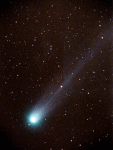 What are Comet Tails Made Of?
26.03.1996
The tail of comet Hyakutake, visible in this recent color image, is composed of dust and gas driven off the icy comet nucleus by the Sun's heat and blown away by the solar wind. Bathed in solar ultraviolet light, the gas molecules break down and are excited, producing a characteristic glow.
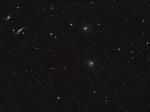 Stars, Galaxies, and Comet Tempel 1
12.05.2005
Faint comet Tempel 1 sports a fuzzy blue-tinted tail, just right of center in this lovely field of stars. Recorded on May 3rd slowly sweeping through the constellation Virgo, periodic comet Tempel 1 orbits the Sun once every 5.5 years.
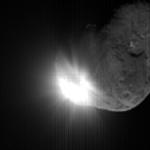 Thirteen Seconds After Impact
5.07.2005
Fireworks came early on July 4th when, at 1:52am EDT, the Deep Impact spacecraft's probe smashed into the surface of Comet Tempel 1's nucleus at ten kilometers per second. The well-targeted impactor probe was vaporized as it blasted out an expanding cloud of material, seen here 13 seconds after the collision.
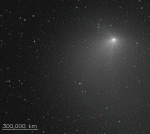 Comet Hale-Bopp Fades
17.09.1996
Comet Hale-Bopp has faded in the past few weeks. For Hale-Bopp, promised as the Great Comet of 1997, this was a bit of a disappointment -- but not entirely unexpected. Comet Hale-Bopp continues to approach...
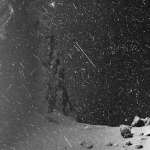 The Snows of Churyumov Gerasimenko
26.04.2018
You couldn't really be caught in this blizzard while standing by a cliff on Churyumov-Gerasimenko, also known as comet 67P. Orbiting the comet in June of 2016 the Rosetta spacecraft's narrow angle...
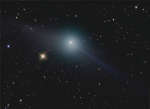 The Opposing Tails of Comet Garradd
28.02.2012
Why does Comet Garradd have two tails? Visible on the left, Comet Garradd's dust tail is composed of ice and dust bits that trial the comet in its orbit around the Sun. Visible...
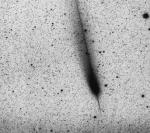 Hale Bopp: A Continuing Tail
20.02.1998
Where is Hale-Bopp now? The Great Comet of 1997, one of the largest and most active comets ever, is outbound about 400 million miles from the sun. Too faint for viewing without telescopes or binoculars, Hale-Bopp is presently positioned in the very southerly constellation of Pictor.
|
January February March April |
|||||||||||||||||||||||||||||||||||||||||||||||||