
|
You entered: dark
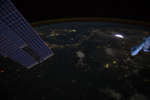 A Dark Earth with a Red Sprite
29.08.2012
There is something very unusual in this picture of the Earth -- can you find it? A fleeting phenomenon once thought to be only a legend has been newly caught if you know just where to look.
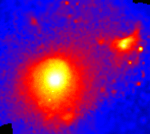 The Virgo Cluster: Hot Plasma and Dark Matter
19.04.1996
This ROSAT image of the Virgo cluster of galaxies reveals a hot X-ray emitting plasma or gas with a temperature of 10-100 million degrees pervading the cluster. False colors have been used to represent the intensity of X-ray emission.
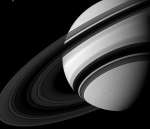 Saturns Rings from the Dark Side
31.12.2012
What do Saturn's rings look like from the dark side? From Earth, we usually see Saturn's rings from the same side of the ring plane that the Sun illuminates them -- one might call this the bright side.
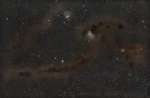 Dark Markings of the Sky
25.04.2009
Based on wide field photographs, American astronomer Edward Emerson Barnard cataloged the dark markings of the sky in the early 20th century. Barnard's markings are dark nebulae, interstellar clouds of obscuring gas and dust.
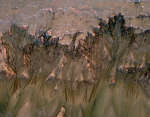 Seasonal Dark Streaks on Mars
8.08.2011
What is causing these dark streaks on Mars? A leading hypothesis is flowing -- but quickly evaporating -- water. The streaks, visible in dark brown near the image center, appear in the Martian spring and summer but fade in the winter months, only to reappear again the next summer.
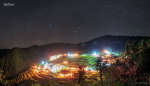 Dark Skies: Turn on the Night
16.05.2019
Have you ever experienced a really dark night sky? One common and amazing feature is the glowing band of our Milky Way galaxy stretching from horizon to horizon. If you live in or near...
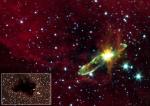 Young Star, Dark Cloud
26.12.2003
High-speed outflows of molecular gas from a young stellar object glow in infrared light, revealing themselves in this recent false-color image from the Spitzer Space Telescope. Cataloged as HH (Herbig-Haro) 46/47 the infrared source...
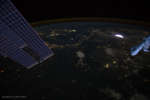 A Dark Earth with a Red Sprite
20.12.2015
There is something very unusual in this picture of the Earth -- can you find it? A fleeting phenomenon once thought to be only a legend has been newly caught if you know just where to look.
 The Dark River to Antares
21.02.2015
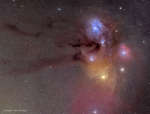
Connecting the Pipe Nebula to the colorful region near bright star Antares is a dark cloud dubbed the Dark River, flowing from the picture's left edge. Murky looking, the Dark River's appearance is caused by dust obscuring background starlight, although the dark nebula contains mostly hydrogen and molecular gas.
 A Dark Pulsar in CTA 1
21.10.2008
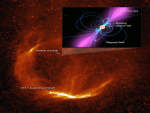
Where's the pulsar? Previously, the nebula CTA 1 showed an expanding supernova remnant, a jet, and a point source expected to be a pulsar -- a rotating neutron star producing pulses at radio energies. But no radio pulses were detected.
|
January February March April May June July August September |
|||||||||||||||||||||||||||||||||||||||||||||||||