
|
You entered: naked eye
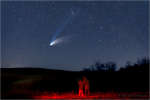 Hale Bopp: The Great Comet of 1997
13.10.2013
Sixteen years ago, Comet Hale-Bopp rounded the Sun and offered a dazzling spectacle in planet Earth's night. This stunning view, recorded shortly after the comet's 1997 perihelion passage, features the memorable tails of Hale-Bopp -- a whitish dust tail and blue ion tail.
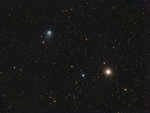 Comet Garradd and Messier 15
6.08.2011
Recorded on August 2, this telescopic composite image catches Comet Garradd (C/2009 P1) in the same field of view as globular star cluster M15. The celestial scene would have been a rewarding one for influential 18th century comet hunter Charles Messier.
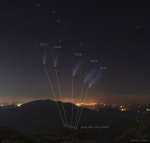 The Shifting Tails of Comet NEOWISE
12.08.2020
Keep your eye on the ion tail of Comet NEOWISE. A tale of this tail is the trail of the Earth. As with all comets, the blue ion tail always points away from the Sun. But as Comet C/2020 F3 (NEOWISE) rounded our Sun, its ion tail pointed in slightly different directions.
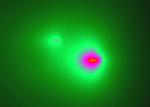 Another Comet LINEAR Breaks Up
21.05.2001
Last year, a different comet LINEAR (C/1999 S4) broke up. This year, a comet first imaged by the Lincoln Near Asteroid Research (LINEAR) telescope in New Mexico on 2001 January 3, is also breaking up.
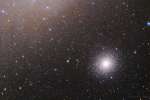 47 Tuc Near the Small Magellanic Cloud
6.12.2012
Globular star cluster 47 Tucanae is a jewel of the southern sky. Also known as NGC 104, it roams the halo of our Milky Way Galaxy along with around 200 other globular star clusters.
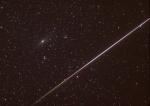 Island Universe, Cosmic Sand
23.08.2002
On August 13, while counting Perseid meteors under dark, early morning Arizona skies, Rick Scott set out to photograph their fleeting but fiery trails. The equipment he used included a telephoto lens and fast color film. After 21 pictures he'd caught only two meteors, but luckily this was one of them.
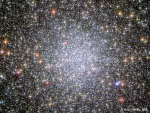 Globular Star Cluster 47 Tuc
19.05.2015
Globular star cluster 47 Tucanae is a jewel box of the southern sky. Also known as NGC 104, it roams the halo of our Milky Way Galaxy along with over 150 other globular star clusters.
 Island Universe, Cosmic Sand
2.08.2003
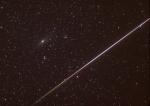
On August 13, 2002, while counting Perseid meteors under dark, early morning Arizona skies, Rick Scott set out to photograph their fleeting but fiery trails. The equipment he used included a telephoto lens and fast color film. After 21 pictures he'd caught only two meteors, but luckily this was one of them.
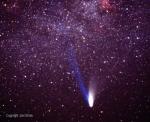 Exploring Comet Tails
13.04.2000
Comets are known for their tails. In the spring of 1997 and 1996 Comet Hale-Bopp (above) and Comet Hyakutake gave us stunning examples as they passed near the Sun. These extremely active comets were...
 Introducing Comet Garradd
27.07.2011
Another large snowball is falling toward the Sun. Comet Garradd was discovered two years ago by Gordon Garradd in Australia, and is currently visible through a small telescope at visual magnitude nine. Officially designated...
|
January February March April May June July August |
||||||||||||||||||||||||||||||||||||||||||||||||||||||||