
|
You entered: nearby stars
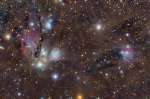 NGC 2170: Celestial Still Life
14.01.2013
In this celestial still life composed with a cosmic brush, dusty nebula NGC 2170 shines left of image center. Reflecting the light of nearby hot stars, NGC 2170 is joined by other bluish reflection nebulae, a red emission region, many dark absorption nebulae, and a backdrop of colorful stars.
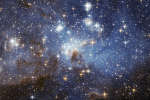 Star Forming Region LH 95
12.03.2008
How do stars form? To better understand this complex and chaotic process, astronomers used the Hubble Space Telescope to image in unprecedented detail the star forming region LH 95 in the nearby Large Magellanic Cloud galaxy.
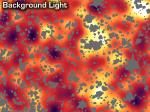 Light from the First Stars
2.01.2007
What were the first stars like? No one is yet sure. Our Sun is not a first-generation star. It is not even second generation. The first stars to appear in the universe likely came and went about 13 billion years ago.
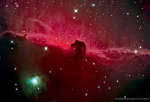 The Horsehead Nebula
31.12.2013
The Horsehead Nebula is one of the most famous nebulae on the sky. It is visible as the dark indentation to the red emission nebula in the center of the above photograph. The horse-head feature is dark because it is really an opaque dust cloud that lies in front of the bright red emission nebula.
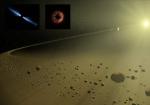 Debris Disks Surround Distant Suns
10.12.2004
In this dramatic artist's vision, debris along the outer reaches of a planet forming disk orbits in the glare of a distant sun. But inset are actual images of such disks around two nearby stars - AU Microscopii (top left; edge-on) and HD107146 (right: face-on) - as seen by the Hubble Space Telescope.
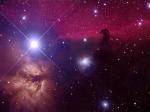 Orions Horsehead Nebula
29.01.2003
The Horsehead Nebula is one of the most famous nebulae on the sky. It is visible as the dark indentation to the red emission nebula seen above and to the right of center in the above photograph. The bright star on the left is located in the belt of the familiar constellation of Orion.
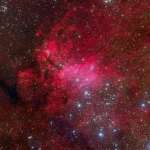 IC 4628: The Prawn Nebula
7.09.2012
South of Antares, in the tail of the nebula-rich constellation Scorpius, lies emission nebula IC 4628. Nearby hot, massive stars, millions of years young, radiate the nebula with invisible ultraviolet light, stripping electrons from atoms. The electrons eventually recombine with the atoms to produce the visible nebular glow, dominated by the red emission of hydrogen.
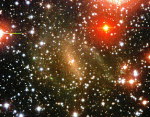 Galaxy Dwingeloo 1 Emerges
1.03.1997
Sometimes you can't see the forest for the trees. But if you look closely at the center of the above photograph, you will see a whole spiral galaxy behind the field of stars.
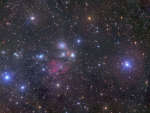 NGC 2170: Celestial Still Life
14.01.2009
Is this a painting or a photograph? In this beautiful celestial still life composed with a cosmic brush, dusty nebula NGC 2170 shines near the image center. Reflecting the light of nearby hot stars...
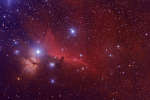 Orion s Horsehead Nebula
21.02.2008
The Horsehead Nebula is one of the most famous nebulae on the sky. It is visible as the dark indentation to the red emission nebula seen just below and left of center in the this photograph. The brightest star on the left is located in the belt of the familiar constellation Orion.
|
January February March April May June July August |
||||||||||||||||||||||||||||||||||||||||||||||||||||||||