
|
You entered: shock wave
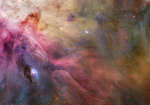 LL Ori and the Orion Nebula
3.02.2013
This esthetic close-up of cosmic clouds and stellar winds features LL Orionis, interacting with the Orion Nebula flow. Adrift in Orion's stellar nursery and still in its formative years, variable star LL Orionis produces a wind more energetic than the wind from our own middle-aged Sun.
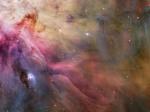 LL Ori and the Orion Nebula
20.01.2006
This esthetic close-up of cosmic clouds and stellar winds features LL Orionis, interacting with the Orion Nebula flow. Adrift in Orion's stellar nursery and still in its formative years, variable star LL Orionis produces a wind more energetic than the wind from our own middle-aged Sun.
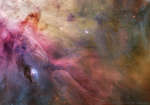 LL Ori and the Orion Nebula
18.02.2018
Stars can make waves in the Orion Nebula's sea of gas and dust. This esthetic close-up of cosmic clouds and stellar winds features LL Orionis, interacting with the Orion Nebula flow. Adrift...
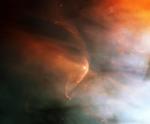 LL Orionis: When Cosmic Winds Collide
15.11.2003
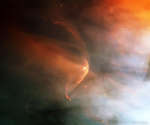
This arcing, graceful structure is actually a bow shock about half a light-year across, created as the wind from young star LL Orionis collides with the Orion Nebula flow. Adrift in Orion's stellar...
 LL Orionis: When Cosmic Winds Collide
22.05.2016
What created this great arc in space? This arcing, graceful structure is actually a bow shock about half a light-year across, created as the wind from young star LL Orionis collides with the Orion Nebula flow.
 New Shocks For Supernova 1987A
17.02.2000
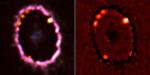
In February of 1987, astronomers witnessed the brightest supernova of modern times - supernova 1987A in the Large Magellanic Cloud. Mysterious rings of material surrounding the expanding stellar debris were soon emitting a visible glow excited by intense light from the explosion.
 The Red Spider Planetary Nebula
24.07.2001
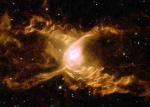
Oh what a tangled web a planetary nebula can weave. The Red Spider Planetary Nebula shows the complex structure that can result when a normal star ejects its outer gases and becomes a white dwarf star.
 The Red Spider Planetary Nebula
29.10.2012
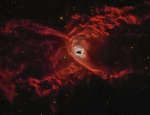
Oh what a tangled web a planetary nebula can weave. The Red Spider Planetary Nebula shows the complex structure that can result when a normal star ejects its outer gases and becomes a white dwarf star.
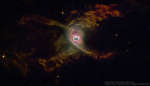 The Red Spider Planetary Nebula
19.04.2017
Oh what a tangled web a planetary nebula can weave. The Red Spider Planetary Nebula shows the complex structure that can result when a normal star ejects its outer gases and becomes a white dwarf star.
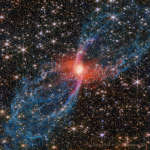 APOD: 2026 February 3 Б Red Spider Planetary Nebula from Webb
3.02.2026
Oh what a tangled web a planetary nebula can weave. The Red Spider Planetary Nebula shows the complex structure that can result when a normal star ejects its outer gases and becomes a white dwarf star.
|
January February March April May June July August September October |
|||||||||||||||||||||||||||||||||||||||||||||||||