
|
You entered: supernova remnant
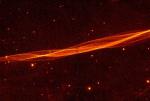 Filaments In The Cygnus Loop
26.04.2000
Subtle and delicate in appearance, these are filaments of shocked interstellar gas -- part of the expanding blast wave from a violent stellar explosion. Recorded in November 1997 with the Wide Field and Planetary Camera 2 onboard the Hubble Space Telescope, the picture is a closeup of a supernova remnant known as the Cygnus Loop.
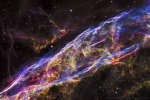 Veil Nebula: Wisps of an Exploded Star
18.09.2017
Wisps like this are all that remain visible of a Milky Way star. About 7,000 years ago that star exploded in a supernova leaving the Veil Nebula. At the time, the expanding cloud was likely as bright as a crescent Moon, remaining visible for weeks to people living at the dawn of recorded history.
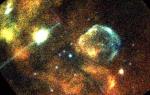 XMM-Newton First Light: X-Rays From The LMC
10.02.2000
Recently the European Space Agency released this and other spectacular "first light" pictures from its new orbiting x-ray observatory, christened XMM-Newton. A churning region of star birth and death in our small neighboring galaxy, the Large Magellanic Cloud (LMC), this field was one of several chosen to test out XMM-Newton's x-ray imaging capabilities.
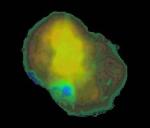 X-Rays From IC 443
2.05.1997
The life-cycles of stars help drive the ecology of our Galaxy, churning, processing, and redistributing matter. Massive stars reach a spectacular evolutionary endpoint - supernovae explosions which blast off their outer layers, violently merging stellar material with the gas and dust of the Milky Way. The supernova remnant IC 443 is typical of the aftermath.
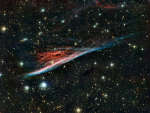 NGC 2736: The Pencil Nebula
24.09.2012
This shock wave plows through space at over 500,000 kilometers per hour. Moving toward to bottom of this beautifully detailed color composite, the thin, braided filaments are actually long ripples in a sheet of glowing gas seen almost edge on. Cataloged as NGC 2736, its narrow appearance suggests its popular name, the Pencil Nebula.
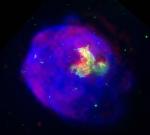 Structure in N63A
31.12.2003
Shells and arcs abound in this false-color, multiwavelength view of supernova remnant N63A, the debris of a massive stellar explosion. The x-ray emission (blue), is from gas heated to 10 million degrees C as knots of fast moving material from the cosmic blast sweep up surrounding interstellar matter.
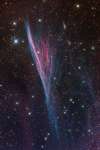 NGC 2736: The Pencil Nebula
7.01.2009
This shock wave plows through space at over 500,000 kilometers per hour. Moving right to left in the beautifully detailed color composite, the thin, braided filaments are actually long ripples in a sheet of glowing gas seen almost edge on. Cataloged as NGC 2736, its narrow appearance suggests its popular name, the Pencil Nebula.
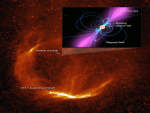 A Dark Pulsar in CTA 1
21.10.2008
Where's the pulsar? Previously, the nebula CTA 1 showed an expanding supernova remnant, a jet, and a point source expected to be a pulsar -- a rotating neutron star producing pulses at radio energies. But no radio pulses were detected.
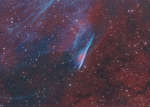 NGC 2736: The Pencil Nebula
21.03.2013
Moving left to right near the center of this beautifully detailed color composite, the thin, bright, braided filaments are actually long ripples in a sheet of glowing gas seen almost edge on. The interstellar shock wave plows through space at over 500,000 kilometers per hour.
 NGC 2736: The Pencil Nebula
14.07.2016
Moving from top to bottom in the frame near the center of this sharply detailed color composite, thin, bright, braided filaments are actually long ripples in a cosmic sheet of glowing gas seen almost edge-on. The shock wave plows through interstellar space at over 500,000 kilometers per hour.
|
January February March April May June July August September October |
|||||||||||||||||||||||||||||||||||||||||||||||||