
|
You entered: NASA
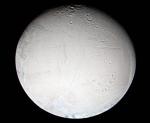 Ski Enceladus
24.02.2005
Small, icy, inner moon of Saturn, Enceladus is only about 500 kilometers in diameter. But the distant world does reflect over 90 percent of the sunlight it receives, giving its surface about the same reflectivity as fresh snow.
 Stardust Capsule Returns to Earth
16.01.2006
A flying saucer from outer space crash-landed in the Utah desert yesterday after being tracked by radar and chased by helicopters and airplanes. Like last time, no space aliens were involved. The saucer...
 Spirit Encounters Soft Ground on Mars
1.06.2009
Will Spirit be able to free itself from soft ground on Mars? The robotic Spirit rover currently rolling across Mars ran into unexpectedly soft ground last month while exploring the red planet. A worry...
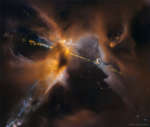 Duel Particle Beams in Herbig Haro 24
11.03.2018
This might look like a double-bladed lightsaber, but these two cosmic jets actually beam outward from a newborn star in a galaxy near you. Constructed from Hubble Space Telescope image data, the stunning scene...
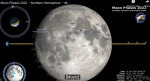 Moon Phases 2022
1.02.2022
What will the Moon phase be on your birthday this year? It is hard to predict because the Moon's appearance changes nightly. As the Moon orbits the Earth, the half illuminated by the Sun first becomes increasingly visible, then decreasingly visible.
 Interplanetary Earth
23.11.2024
In an interplanetary first, on July 19, 2013 Earth was photographed on the same day from two other worlds of the Solar System, innermost planet Mercury and ringed gas giant Saturn. Pictured...
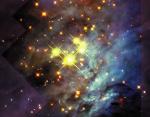 The Brown Dwarfs of Orions Trapezium
30.08.2000
The bright stars above are well known as heart of the Trapezium, an open cluster of stars in the center of the Orion Nebula. The many dim objects, however, are not well known, and have come to attention only on recent images in infrared light.
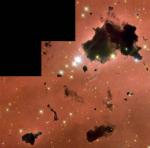 Thackeray's Globules
8.01.2002
Rich star fields and glowing hydrogen gas silhouette dense, opaque clouds of interstellar gas and dust in this Hubble Space Telescope close-up of IC 2944, a bright star forming region in Centaurus, 5,900 light-years away. The largest of these dark globules, first spotted by South African astronomer A. D.
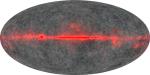 Universe Age from the Microwave Background
17.02.2003
The above sky map tells us the universe is 13.7 billion years old -- but how? At first look, one only sees the microwave glow of gas from our Milky Way Galaxy, coded red, and a spotty pattern of microwaves emitted from the early universe, coded in gray.
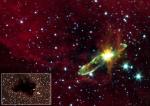 Young Star, Dark Cloud
26.12.2003
High-speed outflows of molecular gas from a young stellar object glow in infrared light, revealing themselves in this recent false-color image from the Spitzer Space Telescope. Cataloged as HH (Herbig-Haro) 46/47 the infrared source...
|
January February March April May June July August September October |
|||||||||||||||||||||||||||||||||||||||||||||||||