
|
You entered: massive stars
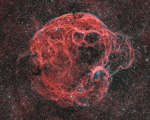 Supernova Remnant Simeis 147
13.01.2022
It's easy to get lost following the intricate, looping, twisting filaments in this detailed image of supernova remnant Simeis 147. Also cataloged as Sharpless 2-240 it goes by the popular nickname, the Spaghetti Nebula.
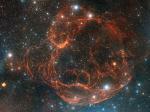 Simeis 147: Supernova Remnant from Palomar
29.11.2005
It's easy to get lost following the intricate filaments in this detailed image of faint supernova remnant Simeis 147. Seen towards the constellation Taurus it covers nearly 3 degrees (6 full moons) on the sky corresponding to a width of 150 light-years at the stellar debris cloud's estimated distance of 3,000 light-years.
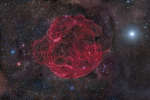 Simeis 147: Supernova Remnant
9.10.2012
It's easy to get lost following the intricate filaments in this detailed mosaic image of faint supernova remnant Simeis 147 (S147). Also cataloged as Sh2-240, it covers nearly 3 degrees or 6 full moons on the sky. That's about 150 light-years at the stellar debris cloud's estimated distance of 3,000 light-years.
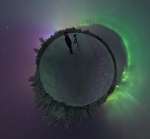 Planet Aurora Borealis
28.01.2012
Illuminated by an eerie greenish light, this remarkable little planet is covered with ice and snow and ringed by tall pine trees. Of course, this little planet is actually planet Earth, and the surrounding stars are above the horizon near Östersund, Sweden.
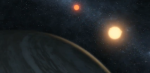 Kepler 16b: A Planet with Two Suns
20.09.2011
If you stay up long enough, you can watch both suns set. Such might be a common adage from beings floating in the atmosphere of Kepler 16b, a planet recently discovered by the space-based Kepler satellite. The above animated video shows how the planetary system might look to a visiting spaceship.
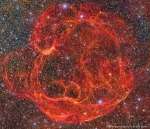 Simeis 147: Supernova Remnant
25.04.2016
It's easy to get lost following the intricate strands of the Spaghetti Nebula. A supernova remnant cataloged as Simeis 147 and Sh2-240, the glowing gas filaments cover nearly 3 degrees -- 6 full moons -- on the sky. That's about 150 light-years at the stellar debris cloud's estimated distance of 3,000 light-years.
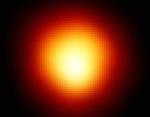 Betelgeuse
19.04.1998
Here is the first direct picture of the surface of a star other than our Sun. Taken by the Hubble Space Telescope in 1995, the atmosphere of Betelgeuse reveals some unexpected features, including a large bright hotspot visible below the center.
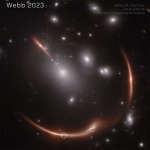 APOD: 2025 October 7 Б SN Encore: A Second Supernova Seen Several Times
7.10.2025
Now a second supernova in this same galaxy is repeating. The cause is the gravitational lens effect of a massive foreground cluster of galaxies (MACS J0138) -- it creates multiple images of a perfectly aligned background galaxy (MRG-M0138). What's particularly interesting is that this background galaxy has young stars that keep blowing up.
 Stripping ESO 137 001
28.03.2014
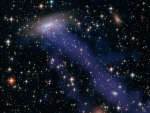
Spiral galaxy ESO 137-001 hurtles through massive galaxy cluster Abell 3627 some 220 million light years away. The distant galaxy is seen in this colorful Hubble/Chandra composite image through a foreground of the Milky Way's stars toward the southern constellation Triangulum Australe.
 Stripping ESO 137-001
1.08.2015
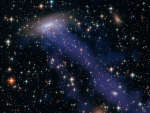
Spiral galaxy ESO 137-001 hurtles through massive galaxy cluster Abell 3627 some 220 million light years away. The distant galaxy is seen in this colorful Hubble/Chandra composite image through a foreground of the Milky Way's stars toward the southern constellation Triangulum Australe.
|
January February March April |
|||||||||||||||||||||||||||||||||||||||||||||||||