
|
You entered: galaxies
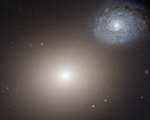 Elliptical M60, Spiral NGC 4647
28.01.2016
Giant elliptical galaxy M60 and spiral galaxy NGC 4647 do look like an odd couple in this sharp cosmic portrait from the Hubble Space Telescope. But they are found in a region of space where galaxies tend to gather, on the eastern side of the nearby Virgo Galaxy Cluster.
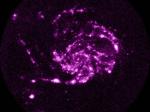 M101: An Ultraviolet View
10.06.2000
This picture of giant spiral galaxy Messier 101 (M101) was taken by the Ultraviolet Imaging Telescope (UIT). UIT flew into orbit as part of the Astro 2 mission on-board the Space Shuttle Endeavour in March 1995.
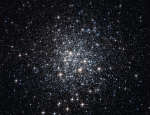 M72: A Globular Cluster of Stars
19.08.2012
Globular clusters once ruled the Milky Way. Back in the old days, back when our Galaxy first formed, perhaps thousands of globular clusters roamed our Galaxy. Today, there are less than 200 left. Many globular clusters were destroyed over the eons by repeated fateful encounters with each other or the Galactic center.
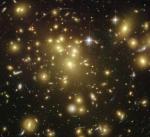 Abell 1689 Warps Space
9.01.2003
Two billion light-years away, galaxy cluster Abell 1689 is one of the most massive objects in the Universe. In this view from the Hubble Space Telescope's Advanced Camera for Surveys, Abell...
 Spitzer s M101
25.07.2008
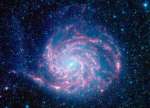
Big, beautiful spiral galaxy M101 is one of the last entries in Charles Messier's famous catalog, but definitely not one of the least. About 170,000 light-years across, this galaxy is enormous, almost twice the size of our own Milky Way Galaxy.
 M81 in Ursa Major
27.04.2007
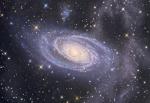
One of the brightest galaxies in planet Earth's sky and similar in size to the Milky Way, big, beautiful spiral M81 lies 11.8 million light-years away in the northern constellation Ursa Major. This...
 NGC 3621: Far Beyond the Local Group
24.02.2017
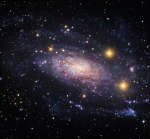
Far beyond the local group of galaxies lies NGC 3621, some 22 million light-years away. Found in the multi-headed southern constellation Hydra, the winding spiral arms of this gorgeous island universe are loaded with luminous blue star clusters, pinkish starforming regions, and dark dust lanes.
 NGC 4676: When Mice Collide
26.04.2009
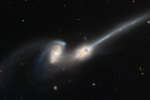
These two mighty galaxies are pulling each other apart. Known as "The Mice" because they have such long tails, each spiral galaxy has likely already passed through the other. They will probably collide again and again until they coalesce.
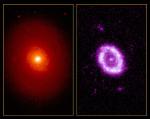 M94: Beyond the Blue
13.06.2001
Today's galaxy, M94 (NGC 4736), lies 15 million light-years away in the constellation Canes Venatici. In the red light image (left), its very bright nucleus and tightly wound spiral arms seem to slowly fade into a faint outer disk.
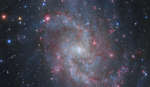 The Hydrogen Clouds of M33
7.10.2016
Gorgeous spiral galaxy M33 seems to have more than its fair share of glowing hydrogen gas. A prominent member of the local group of galaxies, M33 is also known as the Triangulum Galaxy and lies about 3 million light-years distant.
|
January February March April May June July August September October |
|||||||||||||||||||||||||||||||||||||||||||||||||