
|
You entered: massive stars
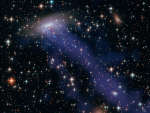 Stripping ESO 137-001
25.08.2018
Spiral galaxy ESO 137-001 hurtles through massive galaxy cluster Abell 3627 some 220 million light years away. The distant galaxy is seen in this colorful Hubble/Chandra composite image through a foreground of the Milky Way's stars toward the southern constellation Triangulum Australe.
 The First Image of an Extra Solar Planet
10.05.2005
It's the faint red object, not the bright white one that might be a historic find. The white object is surely a brown dwarf star. Quite possibly, however, the red object is the first direct image of a planet beyond our Solar System.
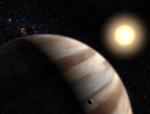 Extra Solar Planetary Atmosphere Detected
28.11.2001
By directly detecting the atmosphere of a planet outside our Solar System, humanity has taken another small step toward finding extraterrestrial life. The unexpected detection by David Charbonneau (Caltech) and associates came from Hubble Space Telescope observations of Sun-like star HD 209458.
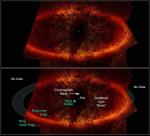 Ring Around Fomalhaut
1.07.2005
Fomalhaut (sounds like "foam-a-lot") is a bright, young, star, a mere 25 light-year trip from planet Earth in the direction of the constellation Piscis Austrinus. Earlier infrared observations identified a torus of cold material...
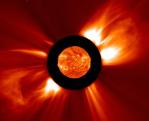 Double Trouble Solar Bubbles
16.05.2002
During April and May, attention has been focused on the western evening sky, presenting its spectacle of bright planets and crescent moons shortly after sunset. Meanwhile, the Sun itself has not been just sinking quietly below the horizon.
 Trees, Stars, Aurora
9.02.2012
Have you ever seen an aurora? Auroras are occurring again with increasing frequency. With the Sun being unusually dormant over the past four years, the amount of Sun-induced auroras has been unusually low. More recently, however, our Sun has become increasingly active and exhibiting a greater abundance of sunspots, flares, and coronal mass ejections.
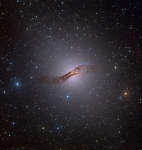 Centaurus A
17.03.2022
A mere 11 million light-years away, Centaurus A is the closest active galaxy to planet Earth. Spanning over 60,000 light-years, the peculiar elliptical galaxy also known as NGC 5128, is featured in this sharp telescopic view.
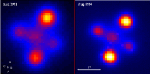 Microlensing of the Einstein Cross
11.07.1995
The famous "Einstein Cross" is a case where a single object is seen four times. Here a very distant QSO happened to be placed right behind a massive galaxy. The gravitational effect...
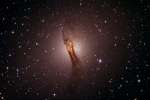 Centaurus A
13.03.2010
Only 11 million light-years away, Centaurus A is the closest active galaxy to planet Earth. Spanning over 60,000 light-years, the peculiar elliptical galaxy, also known as NGC 5128, is featured in this sharp color image.
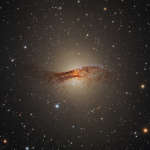 Centaurus A
12.07.2018
Only 11 million light-years away, Centaurus A is the closest active galaxy to planet Earth. Spanning over 60,000 light-years, the peculiar elliptical galaxy also known as NGC 5128, is featured in this sharp telescopic view.
|
January February March April |
|||||||||||||||||||||||||||||||||||||||||||||||||