
|
You entered: light
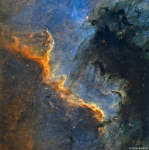 The Cygnus Wall of Star Formation
14.08.2022
The North America nebula on the sky can do what the North America continent on Earth cannot -- form stars. Specifically, in analogy to the Earth-confined continent, the bright part that appears as Central America and Mexico is actually a hot bed of gas, dust, and newly formed stars known as the Cygnus Wall.
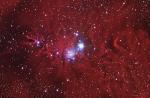 Fox Fur, the Unicorn, and a Christmas Tree
27.02.2003
Glowing hydrogen gas fills this gorgeously detailed sky view centered on the variable star S Mon in the faint but fanciful constellation Monoceros, the Unicorn. A star forming region (NGC 2264), the complex jumble...
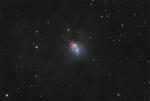 Dusty NGC 1300
6.10.2006
Dusty NGC 1333 is seen in visible light as a reflection nebula, dominated by bluish hues characteristic of starlight reflected by dust. But at longer infrared wavelengths, the interstellar dust itself glows. Moving your...
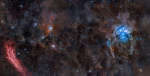 Seven Sisters Versus California
2.11.2009
On the upper right, dressed in blue, is the Pleiades. Also known as the Seven Sisters and M45, the Pleiades is one of the brightest and most easily visible open clusters on the sky. The Pleiades contains over 3,000 stars, is about 400 light years away, and only 13 light years across.
 Pleiades to Hyades
17.11.2011
This cosmic vista stretches almost 20 degrees across the gentle constellation Taurus. It begins at the Pleiades and ends at the Hyades, two of the best known star clusters in planet Earth's sky. At left, the lovely Pleiades star cluster is about 400 light-years away.
 Twisting with NGC 3718
3.08.2013
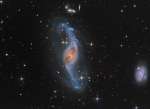
A careful look at this colorful cosmic snapshot reveals a surprising number of galaxies both near and far toward the constellation Ursa Major. The most striking is NGC 3718, the warped spiral galaxy near picture center. NGC 3718's spiral arms look twisted and extended, mottled with young blue star clusters.
 M45: The Pleiades Star Cluster
16.06.2015
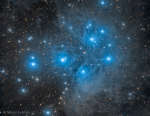
Have you ever seen the Pleiades star cluster? Even if you have, you probably have never seen it as dusty as this. Perhaps the most famous star cluster on the sky, the bright stars of the Pleiades can be seen without binoculars from even the depths of a light-polluted city.
 The Helix Nebula from CFHT
2.01.2018
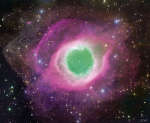
Will our Sun look like this one day? The Helix Nebula is one of brightest and closest examples of a planetary nebula, a gas cloud created at the end of the life of a Sun-like star.
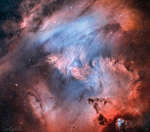 Wide Field: Fox Fur, Unicorn, and Christmas Tree
9.03.2020
What do the following things have in common: a cone, the fur of a fox, and a Christmas tree? Answer: they all occur in the constellation of the unicorn (Monoceros). Pictured as a star...
 APOD: 2025 June 29 Б Dark Sand Cascades on Mars
28.06.2025
Are these trees growing on Mars? No. Groups of dark brown streaks have been photographed by the Mars Reconnaissance Orbiter on melting pinkish sand dunes covered with light frost. The featured image was taken in 2008 April near the North Pole of Mars.
|
January February March April May June July August September October |
|||||||||||||||||||||||||||||||||||||||||||||||||