
|
You entered: space
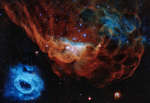 Hubble s Cosmic Reef
25.04.2020
These bright ridges of interstellar gas and dust are bathed in energetic starlight. With its sea of young stars, the massive star-forming region NGC 2014 has been dubbed the Cosmic Reef. Drifting just...
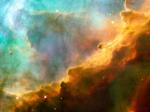 APOD: 2004 August 28- M17: A Hubble Close-Up
28.08.2004
Sculpted by stellar winds and radiation, these fantastic, undulating shapes lie within the stellar nursery known as M17, the Omega Nebula, some 5,500 light-years away in the nebula-rich constellation Sagittarius. The lumpy features...
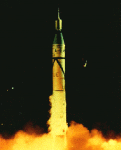 The First Explorer
6.02.1999
The first US spacecraft was Explorer 1. The cylindrical 30 pound satellite was launched (above) as the fourth stage of a Jupiter-C rocket (a modified US Army Redstone ballistic missile) and achieved orbit on January 31, 1958.
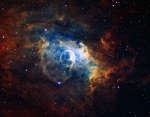 NGC 7635: The Bubble Nebula
11.10.2011
It's the bubble versus the cloud. NGC 7635, the Bubble Nebula, is being pushed out by the stellar wind of massive central star BD+602522. Next door, though, lives a giant molecular cloud, visible to the right. At this place in space, an irresistible force meets an immovable object in an interesting way.
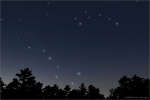 The Big Dipper
21.04.2013
Do you see it? This common question frequently precedes the rediscovery of one of the most commonly recognized configurations of stars on the northern sky: the Big Dipper. This grouping of stars is one of the few things that has likely been seen, and will be seen, by every generation.
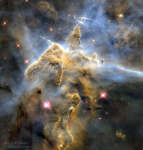 Mountains of Dust in the Carina Nebula
1.08.2022
It's stars versus dust in the Carina Nebula and the stars are winning. More precisely, the energetic light and winds from massive newly formed stars are evaporating and dispersing the dusty stellar nurseries in which they formed.
 Messier 87
20.02.2025
Enormous elliptical galaxy Messier 87 is about 50 million light-years away. Also known as NGC 4486, the giant galaxy holds trillions of stars compared to the mere billions of stars in our large spiral Milky Way. M87 reigns as the large central elliptical galaxy in the Virgo galaxy cluster.
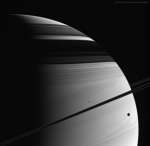 APOD: 2026 June 16 Б Moons, Rings, Shadows, Clouds: Saturn Cassini
16.06.2026
While cruising around Saturn, be on the lookout for picturesque arrangements of moons, rings, and shadows. One such striking sight occurred in 2005 and was captured by the then Saturn-orbiting Cassini spacecraft.
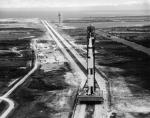 Moon Rocket
20.07.1999
On July 20, 1969, only four days after leaving planet Earth 250,000 miles behind them, Apollo 11 astronauts landed on the moon - the first humans to reach another celestial body. But the Saturn...
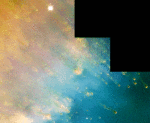 At the Edge of the Helix
22.04.1996
While exploring the inner edge of the Helix Nebula with the Hubble Space Telescope's Wide Field Planetary Camera 2, astronomers were able to produce this striking image - rich in details of an exotic environment.
|
January February March April May June July August September October |
|||||||||||||||||||||||||||||||||||||||||||||||||