
|
You entered: star cluster
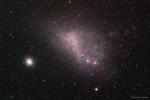 APOD: 2007 October 1- The Small Cloud of Magellan
1.10.2007
Portuguese navigator Ferdinand Magellan and his crew had plenty of time to study the southern sky during the first circumnavigation of planet Earth. As a result, two celestial wonders easily visible for southern hemisphere skygazers are known as the Clouds of Magellan.
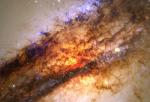 The Center of Centaurus A
22.08.1999
A fantastic jumble of young blue star clusters, gigantic glowing gas clouds, and imposing dark dust lanes surrounds the central region of the active galaxy Centaurus A. This mosaic of Hubble Space Telescope images taken in blue, green, and red light has been processed to present a natural color picture of this cosmic maelstrom.
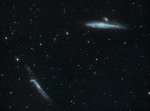 The Whale and the Hockey Stick
21.08.2009
NGC 4631 is a big beautiful spiral galaxy seen edge-on (top right) only 25 million light-years away towards the small northern constellation Canes Venatici. This galaxy's slightly distorted wedge shape suggests to some a cosmic herring and to others the popular moniker of The Whale Galaxy.
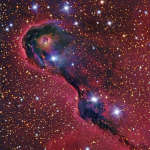 An Elephant s Trunk in Cepheus
16.01.2018
With image data from telescopes large and small, this close-up features the dusty Elephant's Trunk Nebula. It winds through the emission nebula and young star cluster complex IC 1396, in the high and far off constellation of Cepheus. Also known as vdB 142, the cosmic elephant's trunk is over 20 light-years long.
 Most of Comet Tsuchinshan ATLAS
18.10.2024
On October 14 it was hard to capture a full view of Comet C/2023 A3 Tsuchinshan-ATLAS. Taken after the comet's closest approach to our fair planet, this evening skyview almost does though. With...
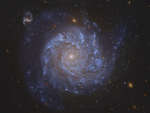 NGC 1309: Spiral Galaxy and Friends
16.01.2013
A gorgeous spiral galaxy some 100 million light-years distant, NGC 1309 lies on the banks of the constellation of the River (Eridanus). NGC 1309 spans about 30,000 light-years, making it about one third the size of our larger Milky Way galaxy.
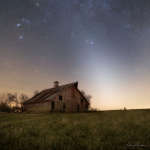 Zodiacal Light and Mars
11.03.2021
Just after sunset on March 7, a faint band of light still reaches above the western horizon in this serene, rural Illinois, night skyscape. Taken from an old farmstead, the luminous glow is zodiacal light, prominent in the west after sunset during planet Earth's northern hemisphere spring.
 APOD: 2024 September 24 Б NGC 6727: The Rampaging Baboon Nebula
24.09.2024
This dusty region is forming stars. Part of a sprawling molecular cloud complex that resembles, to some, a rampaging baboon, the region is a relatively close by 500 light-years away toward the constellation Corona Australis. That's about one third the distance of the more famous stellar nursery known as the Orion Nebula.
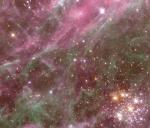 Denizen of the Tarantula Nebula
3.05.2003
The star cluster at lower right, cataloged as Hodge 301, is a denizen of the Tarantula Nebula. An evocative nebula in the southern sky, the sprawling cosmic Tarantula is an energetic star forming region some 168,000 light-years distant in our neighboring galaxy the Large Magellanic Cloud.
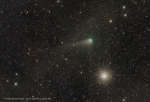 Messier 10 and Comet
21.07.2022
Imaged on July 15 2022, comet C/2017 K2 (PanSTARRS) had a Messier moment, sharing this wide telescopic field of view with globular star cluster Messier 10. Of course M10 was cataloged by 18th century comet hunter Charles Messier as the 10th object on his list of things that were definitely not comets.
|
January February March April May June July August September October |
|||||||||||||||||||||||||||||||||||||||||||||||||