
|
You entered: Earth's moon
 A Martian Halloween
31.10.2005
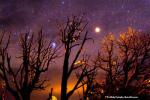
From sunset to sunrise, an unusually bright yellowish orb will hang in the sky this Halloween: Mars. Yesterday, Earth passed Mars as they orbited the Sun, bringing Mars closer than it will be for the next thirteen years. Tonight though, Mars will be nearly as bright as last night, a beacon of extraterrestrial spookiness.
 APOD: 2023 December 4 Б Plane Crossing Crescent Moon
4.12.2023
No, the Moon is not a bow, and no, it did not shoot out a plane like an arrow. What is pictured is a chance superposition. The plane's contrail would normally appear white...
 Eclipse over the Temple of Poseidon
18.01.2010
What's happened to the Sun? The Moon moved to partly block the Sun for a few minutes last week as a partial solar eclipse became momentarily visible across part of planet Earth.
 Flying Over Plutos Moon Charon
22.02.2016
Given some poetic license, there is now scientific evidence that hell has frozen over. To start, Greek mythology holds that Charon is the ferryman of the underworld. Next, recent analysis of data taken...
 Lunar Eclipse Perspectives
5.02.2020
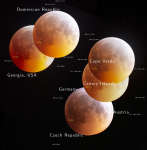
Do we all see the same Moon? Yes, but we all see it differently. One difference is the apparent location of the Moon against background stars -- an effect known as parallax. We humans use the parallax between our eyes to judge depth.
 Clouds, Birds, Moon, Venus
12.05.2013
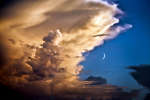
Sometimes the sky above can become quite a show. In early September of 2010, for example, the Moon and Venus converged, creating quite a sight by itself for sky enthusiasts around the globe. From some locations, though, the sky was even more picturesque.
 Eclipsed Moon in the Milky Way
17.06.2011
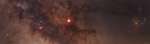
On June 15, the totally eclipsed Moon was very dark, with the Moon itself positioned on the sky toward the center of our Milky Way Galaxy. This simple panorama captures totality from northern Iran in 8 consecutive exposures each 40 seconds long.
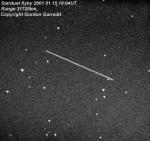 Sail On Stardust
25.01.2001
Spacecraft on long interplanetary voyages often use the planets themselves as gravitational "sling shots" to boost them along their way. Launched in February of 1999 on a historic voyage to a comet, the Stardust spacecraft is no different.
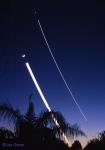 Venus Falls Out of the Evening Sky
3.09.1999
Orbiting closer to the Sun than planet Earth, bright Venus always appears to be near the Sun's position in our sky and often shines near the horizon in twilight hours. In fact, after...
 A Total Solar Eclipse Over China
5.08.2008
What's that black dot over the Sun? The Moon. This past weekend, the Sun went dark during the day as the Moon completely covered it. The total solar eclipse was visible over a thin swath of Earth extending from northern Canada to China.
|
January February March April May June July August September |
|||||||||||||||||||||||||||||||||||||||||||||||||