
|
You entered: planet
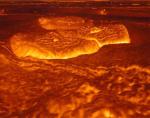 Venus' Once Molten Surface
3.06.1997
If you could look at Venus with radar eyes - this is what you might see. This computer reconstruction of the surface of Venus was created from data from the Magellan spacecraft. Magellan orbited Venus and used radar to map our neighboring planet's surface between 1990 and 1994.
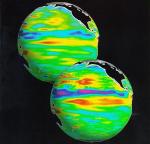 El Nino Water Rhythm
13.01.1998
This year's El Niño is the strongest ever recorded. The large amount of warm water in the Pacific Ocean near the equator is causing unusual weather all over planet Earth.
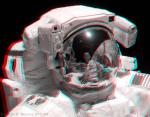 STS 115: Stereo Portrait
30.09.2006
On September 12, astronaut Heidemarie Stefanyshyn-Piper snapped photos of her colleague Joseph Tanner during the STS-115 mission. At the time, the spacesuited pair were working outside the shuttle orbiter Atlantis, some 300 kilometers above planet Earth.
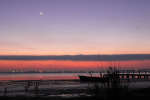 Moon, Mercury, Jupiter, Mars
26.02.2009
When the Moon rose in predawn skies on February 23rd, it sported a sunlit crescent. It also offered early morning risers a tantalizing view of earthshine, the dark portion of the lunar disk illuminated by sunlight reflected from the Earth.
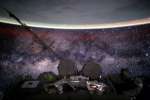 Earth and Milky Way from Space
7.11.2015
Since November 2000, people have been living continuously on the International Space Station. To celebrate humanity's 15th anniversary off planet Earth, consider this snapshot from space of our galaxy and our home world posing together beyond the orbital outpost.
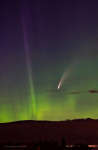 NEOWISE of the North
17.07.2020
After local midnight on July 14 comet NEOWISE was still above the horizon for Goldenrod, Alberta, Canada, just north of Calgary, planet Earth. In this snapshot it makes for an awesome night with dancing displays of the northern lights. The long-tailed comet and auroral displays are beautiful apparitions in the north these days.
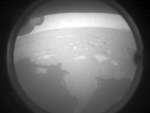 Mars Perseverance Sol 0
19.02.2021
After a 203 day interplanetary voyage, and seven minutes of terror, Perseverance has landed on Mars. Confirmation of the successful landing at Jezero crater was announced from mission control at NASAБs Jet Propulsion Laboratory in Southern California at 12:55 pm PST on February 18.
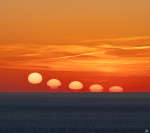 APOD: 2026 April 25 Б The Persistence of Sunlight
25.04.2026
This seaside sunset offered a surreal experience, captured in a sea and skyscape from the west coast of Sardinia, Italy, planet Earth. The Daliesque scene is a composition of sequential exposures made with a camera and long telephoto lens. The Sun is not melting, though.
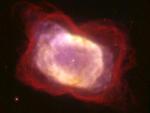 Planetary Nebula NGC 7027 in Infrared
25.03.1998
NGC 7027 is one of the smallest known planetary nebulae. Even so, NGC 7027 is 14,000 times larger than the Earth-Sun distance. Planetary nebula are so named because the first few discovered appeared similar to planets. Planetary nebula are actually dying stars, though, that have recently run out of nuclear fuel.
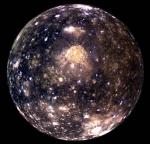 Callisto Enhanced
12.05.1998
Callisto is half rock and half ice. This moon of Jupiter is approximately the size of the planet Mercury, making it the third largest moon in the Solar System, after Ganymede and Titan. Callisto...
|
January February March April May June July August September October |
|||||||||||||||||||||||||||||||||||||||||||||||||